What Is the Roland Aerophone AE-20? A Complete Beginner's Guide
🌐 Read this article in Japanese(この記事を日本語で読む)
Hi, I'm Shuko — a music blogger from Japan.
On this blog, I write about a digital wind instrument called the Aerophone. Have you heard the name somewhere and wondered what kind of instrument it actually is?

An Aerophone? I've never heard of that!
The Aerophone is a wonderful instrument, but it can be surprisingly hard to find one article that gives you the full picture. How does it make sound? How many tones does it have? Should I teach myself or take lessons?
Let's answer all of those questions in one place. This article walks you through the basics: how the Aerophone works, its sounds and fingering options, where you can play it, and how to learn. By the end, you'll have a clear picture of the whole instrument.
Feel free to jump to any section from the table of contents below.
* This page may contain affiliate links.
Contents
What Is the Aerophone?
Let's start with the basics.
The Aerophone is a wind-instrument-shaped electronic instrument made by Roland, the Japanese company known for its synthesizers and digital pianos. You may also see it called a digital saxophone, a digital wind instrument, or a wind synthesizer ("wind synth" for short).
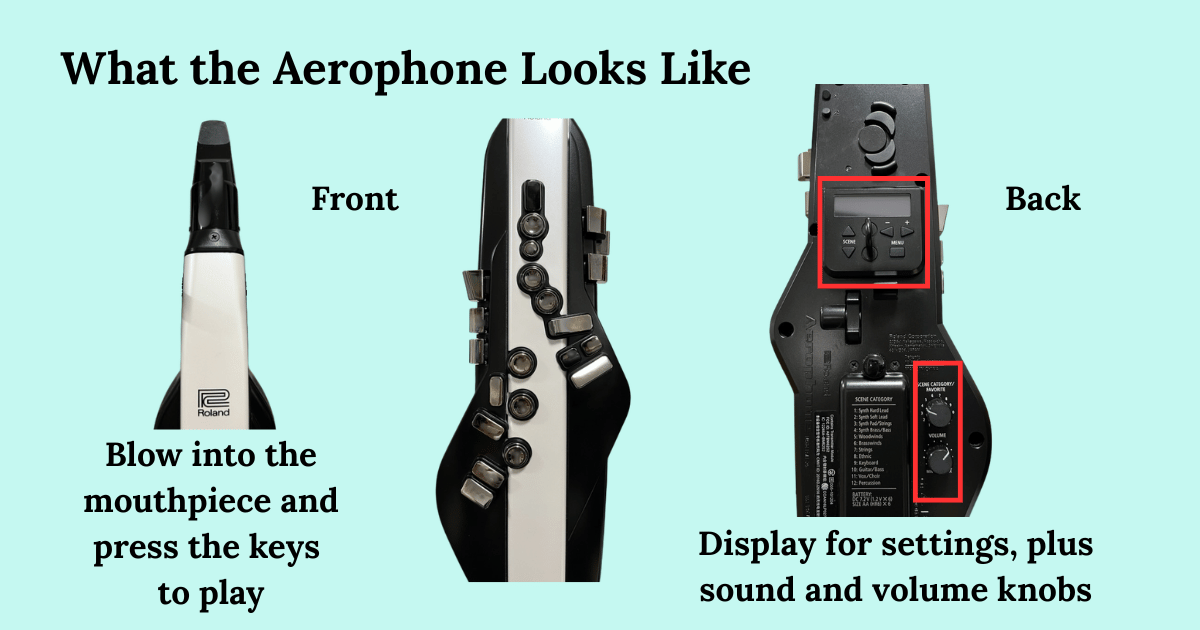
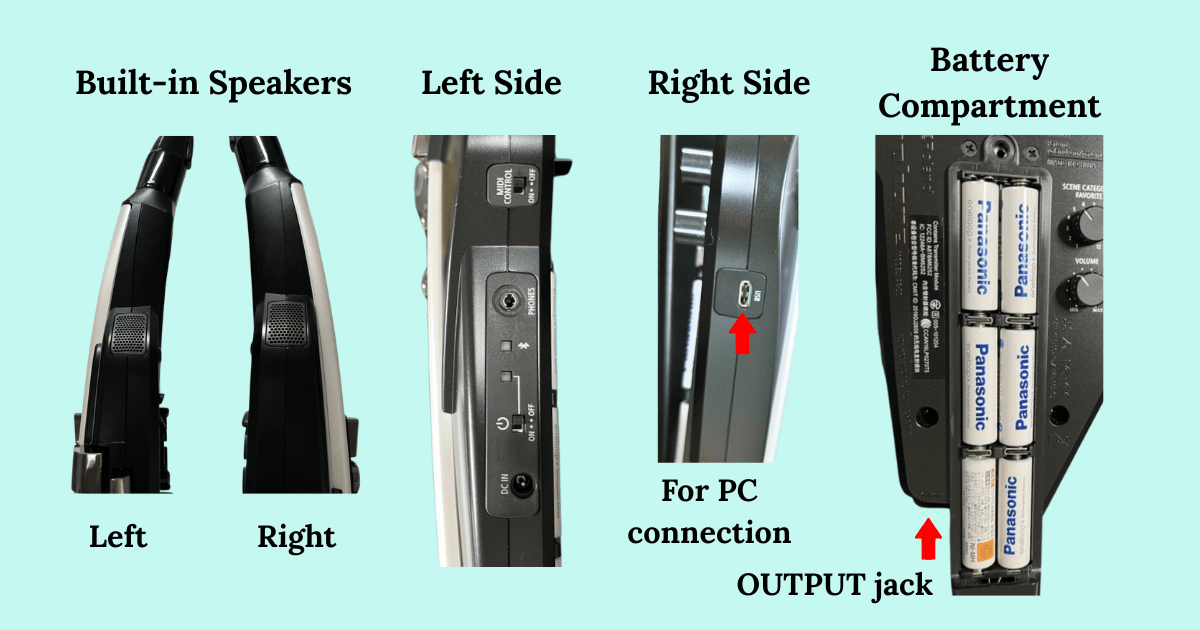
Because it's electronic, it runs on an AC adapter or batteries. You blow into the mouthpiece and press the keys, and the sound comes out of the built-in speakers, your headphones, or an external amplifier.
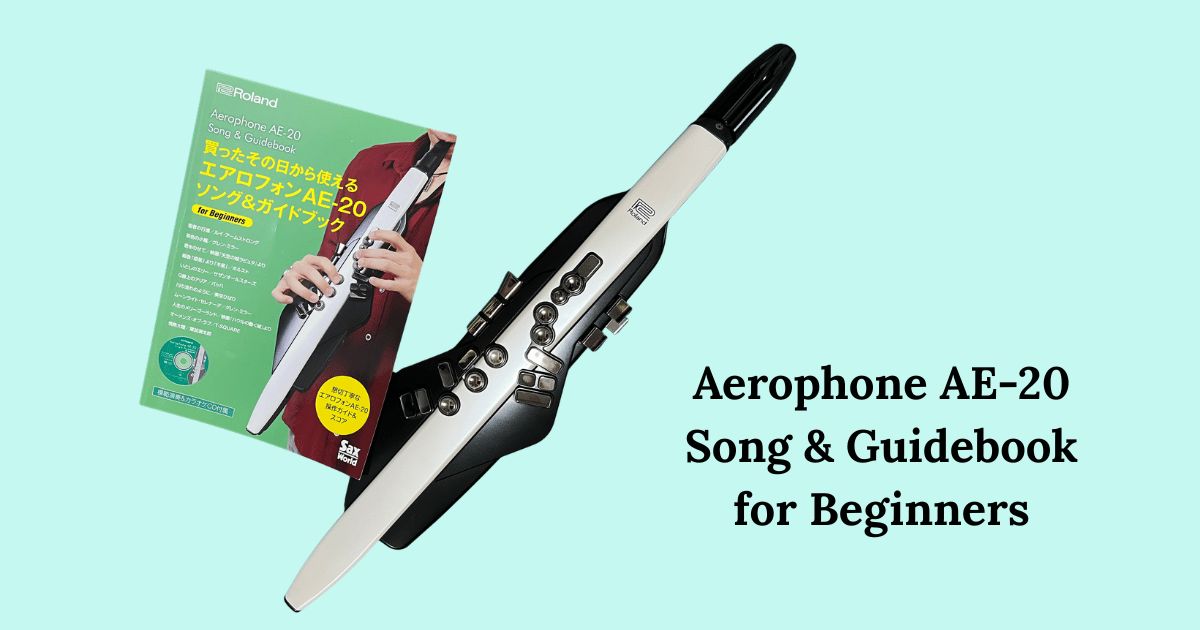
Four models are currently available: the AE-01 (Aerophone mini), AE-05 (Aerophone GO), AE-20 (Aerophone), and AE-30 (Aerophone Pro). I play the AE-20, and that's the model this blog focuses on.
Here's what the AE-20 looks like.
How It Makes Sound
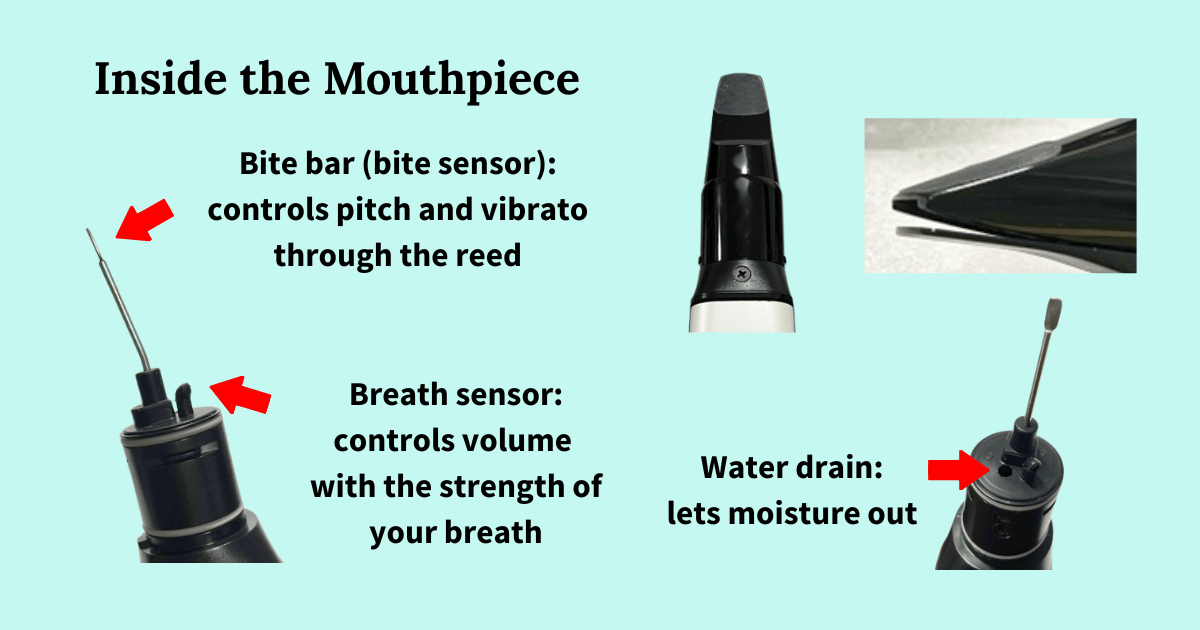
So how does the Aerophone actually produce sound? It comes down to two sensors.
The breath sensor controls volume
The Aerophone's mouthpiece has a reed, but unlike a saxophone, the reed doesn't vibrate to make sound.
Instead, a breath sensor inside the mouthpiece detects how strongly you blow, and that controls the volume and dynamics of each note.
Even a gentle breath is enough to make a sound, so anyone can enjoy it, regardless of age or lung power. And if you prefer more resistance — closer to the feel of an acoustic instrument — you can adjust the settings to get that, too.
The bite sensor controls pitch and expression
The bite sensor responds to the pressure of your mouth on the reed, letting you control pitch and add vibrato. Combined with tonguing and legato playing, it opens up a surprisingly rich range of expression.
Sounds and Fingering
One of the Aerophone's biggest attractions is the sheer variety of sounds — and how flexible the fingering is.
Over 260 built-in sounds
The AE-20 comes with more than 260 sounds. Naturally that includes soprano, alto, tenor, and baritone saxophones, plus other wind instruments like flute, clarinet, and trumpet.
It goes far beyond winds, too: strings like violin and cello, and traditional instruments from around the world such as the shakuhachi (Japanese bamboo flute) and morin khuur (Mongolian horsehead fiddle). There are also organs, guitars, marimbas, and more.
It's not much of an exaggeration to say that almost every instrument you can name is in there somewhere.
Fingering you can choose to fit you
The default fingering follows the saxophone. But you can also switch to recorder, trumpet, flute, clarinet, or the fingering used by another maker's wind synth (E.WI mode).
There are even "right hand only" and "left hand only" modes, and a user setting lets you assign your own custom fingerings to the keys.
Roland Aerophone AE-20
See full specs and details on the official page:
Roland Aerophone AE-20 — Official Product Page
Where You Can Play It
Another convenient thing about the Aerophone: you can change how the sound comes out to match where you're playing.
- At home, through the speakers: the built-in speakers mean you can just switch it on and play.
- At home, through headphones: plug in headphones and you can practice at any hour without disturbing anyone — perfect for apartments.
- In a larger venue: when the built-in speakers aren't enough, connect an amplifier for full, high-quality sound.
Self-Study or Lessons?
If you're thinking about starting the Aerophone, you might be wondering whether to teach yourself or take lessons.
If you've never played a wind instrument before, I recommend lessons.
I started as a complete beginner myself. Making a sound was easy — but my lips hurt, then my neck and hands hurt, and there were moments I nearly gave up.
With a teacher, a professional can tell you exactly what to fix to play better, so you actually feel yourself improving.
It would be such a shame to quit before you discover how deep and rewarding this instrument can be. For me, things really took off after about a year of playing.
Online lessons are an option too
Here in Japan, the music retailer Shimamura Music offers Aerophone lessons taught by saxophone teachers, both in person and online.
Wherever you live, a saxophone teacher who is familiar with wind synths can absolutely teach you the Aerophone — the fingering and breath control carry over. Online lessons make it possible even if there's no teacher nearby, and many offer a trial lesson.
One tip: connecting a small audio mixer lets your teacher hear your playing cleanly, without room noise. I use one for my own online lessons and highly recommend it.
Summary
This article was an introduction to the Aerophone for anyone hearing the name for the first time.
If you'd love to pick up an instrument as a hobby but need to practice quietly at home, the Aerophone is a perfect match.
If you get the chance, try one out at a music store — it's the fastest way to fall for it.
On this blog, I share everything I've learned about the Aerophone as a beginner who started from zero. Take a look around from the menu and find an article that speaks to you!

Let's enjoy the Aerophone together!