EWI, Yamaha YDS, or Aerophone? Choosing Your First Digital Wind Instrument
🌐 Read this article in Japanese(この記事を日本語で読む)
Hi, I'm Shuko, a music blogger from Japan.
Are you thinking about starting a digital wind instrument, but feeling a little lost about which one to pick from all the options out there?

EWI, Yamaha, Aerophone… I keep hearing the names, but honestly I'm not sure how they actually differ.
Each maker is good at slightly different things, and even the way the sound is produced varies from one to the next.
In this article, I'll walk you through the three most talked-about models and three simple ways to choose — by purpose, by price, and by looks — all from the point of view of someone who started as a complete wind-instrument beginner. I hope it helps you find the one that's right for you.
Feel free to jump to any section from the table of contents below.
* This page may contain affiliate links.
Contents
Types of Digital Wind Instruments
"Digital wind instrument" covers a lot of ground, so here are the three that get compared most often.
Akai EWI
Since its release in 1987, the EWI has been almost synonymous with the wind synthesizer. It's well known for being used by fusion players, including the saxophonist of T-SQUARE, a long-running Japanese fusion band.
It's made by Akai Professional, and the current lineup is two models: the EWI 5000 and the EWI Solo.
You can find Akai's official site here.
Yamaha Digital Saxophone
Released starting in 2019, this is a digital saxophone built on Yamaha's acoustic saxophones. It has a one-piece bell (the flared part where the sound comes out), and the sound from the speaker travels into the bell and makes it resonate, giving a realistic playing feel.
The current model is the YDS-150.
A more affordable model, the YDS-120, was also available, but it has since been discontinued.
You can find Yamaha's official YDS-150 page here.
Roland Aerophone
Roland, headquartered in Hamamatsu, Japan, began selling the Aerophone in 2016.
Beyond the saxophone, it's a digital wind instrument that lets you enjoy a wide variety of sounds — woodwinds and brass like flute, clarinet, and trumpet; strings like violin and cello; synthesizers; and even world instruments such as the erhu and the shakuhachi.
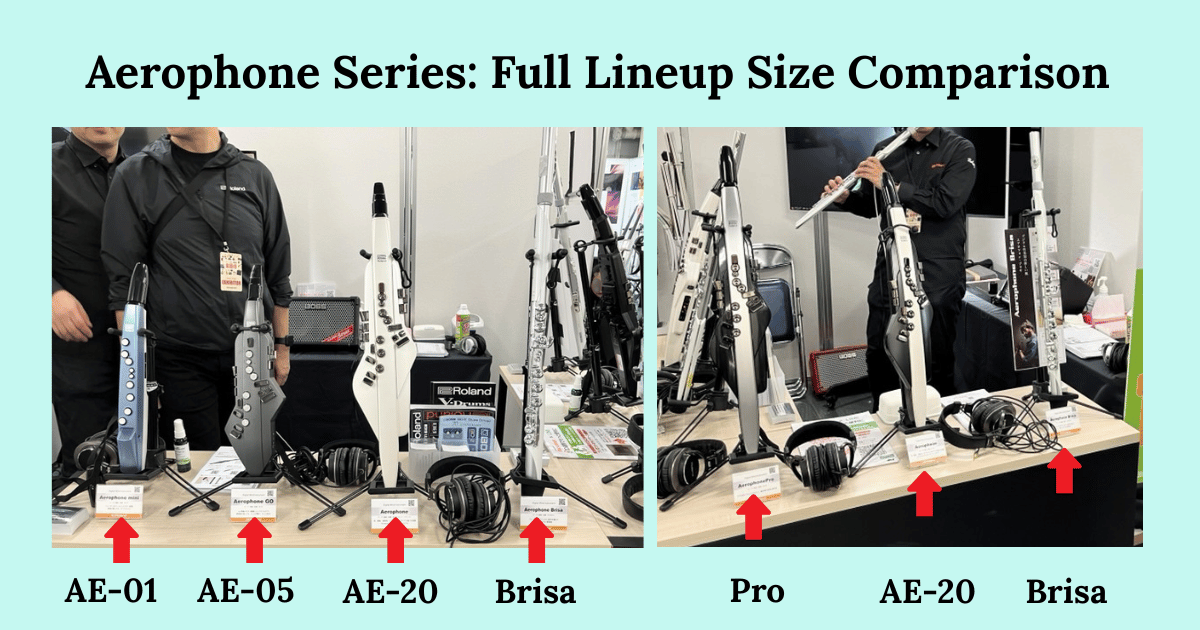
The current lineup includes five models. The very first model, the AE-10, was discontinued in 2022.
- AE-01 Aerophone mini
- AE-05 Aerophone GO
- AE-20 Aerophone (also available in white as the AE-20W)
- AE-30 Aerophone Pro
- AE-Brisa Aerophone Brisa
You can find the Aerophone site here.
Who Actually Plays These?
When you're about to buy one, it's natural to wonder who actually uses these instruments.
From what I've heard at music schools and seen online and on YouTube, there seem to be two very different groups.
Saxophonists often already know about digital wind instruments, and they tend to buy one for quiet practice at home, or for things an acoustic sax can't do — other instruments' tones, MIDI, and so on.
But there's a second group you'll hear from far less often: complete beginners. Some always wanted to play the saxophone. Others — like me — simply found out there was an instrument they could practise at home through headphones, without disturbing anyone. We're quieter online: most beginners who struggle give up before they ever write anything down.
Beyond both groups, though, awareness is still low. People who play other instruments often tell me they've "never even seen an Aerophone before."
That's exactly why I want to keep sharing that beginners can start and have plenty of fun with these instruments, too.

Roland Aerophone AE-20
See full specs and details on the official page:
Roland Aerophone AE-20 — Official Product Page
How to Choose: 3 Approaches
Now that you know the types, it's time to actually pick one. Here's how I'd think it through, from three angles.
Choose by purpose and features
- Want to use it mainly as a synthesizer → EWI
- Want it as a stand-in for a saxophone → Yamaha
- Want to enjoy lots of different tones → Aerophone
Here's how the three compare.
| Comparison | Akai EWI | Yamaha YDS-150 | Aerophone AE-20 |
|---|---|---|---|
| Main character | Traditional wind-synth feel | Close to a real saxophone's playing feel | Wide variety of tones |
| Key structure | Touch sensors | Lever keys, like a sax | Buttons |
| Mouthpiece | Recorder-type | Reed-type (sax-style) | Reed-type |
| Number of sounds | 100 (strong on electronic sounds) | 73 (mostly saxophone) | 250+ (from synths to world instruments) |
| Weight | approx. 0.8 kg (1.8 lb) — fairly light | approx. 1.0 kg (2.2 lb) — brass bell | approx. 1.1 kg (2.4 lb) — nicely stable |
The mouthpiece you bite and the keys you press differ by model.
For the mouthpiece, the EWI is recorder-type, while the Yamaha YDS-150 and the Aerophone are reed-type.
As for the keys, the EWI uses touch sensors and the Aerophone uses buttons, whereas the Yamaha uses lever keys that move much like an acoustic saxophone's.
If you'd like the full technical specs, it's worth checking each manufacturer's official site.
If you want as many tones as possible, the Aerophone AE-20 is my pick.
Choose by price (comparison table)
Specs matter, but so does price. For reference, here are typical current prices at major retailers in the US (Sweetwater) and Europe (Thomann).
You can of course buy from other music stores or online shops, and some sell bundles with a method book, a stand, and so on. Weigh the specs against your budget and take your time deciding.
| Model | Price (USD) | Price (EUR) |
|---|---|---|
| Akai EWI 5000 | $899 | €628 |
| Akai EWI Solo | $549 | approx. €399 |
| Yamaha YDS-150 | $800 | €749 |
| AE-01 (Aerophone mini) | $408 | €280 |
| AE-05 (Aerophone GO) | $612 | €422 |
| AE-20 (Aerophone) | $1,100 | €839 |
| AE-30 (Aerophone Pro) | $1,750 | €1,479 |
* As of July 2026. Approximate street prices; they vary by country, retailer, and sales.
As a budget guideline, the idea is: "around $400 / €300 to try something out (AE-01), or around $1,000 / €800 for a single instrument you'll keep for years (AE-20)."
I'll go into the differences between the Roland models in the comparison section just below.
Choose by looks
When I first saw the Aerophone, I thought, "That looks so cool!" — and I honestly chose it purely on looks. The AE-20 had just come out (released in January 2022), and lots of people were posting reviews on YouTube.
Out of all the sites and videos I watched, two in particular pushed me over the line. Both are in Japanese, but the playing comes across whatever language you speak.
The first was from the saxophonist Mana Arakawa, on her channel "Arakawa Mana no Kimamana Sax" (荒川マナの気まマナさっくす). In her AE-20 review (in Japanese), she flatly says something like, "If you're thinking of starting an instrument → buy it!" — which really gave me a push. She talks so cheerfully that the video makes you want to try it yourself.
The second was from Takahiro Yoshida, a saxophone instructor at Shimamura Music's Kawasaki Le FRONT store, and his performance of the main theme from Detective Conan / Case Closed (in Japanese). It's the kind of video that makes you think how cool — and how satisfying — it would feel to play like that.
Which Roland Aerophone? Comparing All Five Models
For anyone who's leaning toward the Roland Aerophone in particular, here's a comparison of all five current models. The Aerophone range runs from entry-level to pro, and even within the same series the models have quite different personalities.
| Model | Price (USD / EUR) | Sounds | Weight | Best for |
|---|---|---|---|---|
| AE-01 (Aerophone mini) |
$408 / €280 | 6 sounds (+50 via app) |
approx. 500 g (1.1 lb) |
Just want to give it a casual try |
| AE-05 (Aerophone GO) |
$612 / €422 | 11 sounds (+50 via app) |
approx. 700 g (1.5 lb) |
Sax fingering on a smaller budget |
| AE-20 (Aerophone) |
$1,100 / €839 | 250+ sounds | approx. 1.1 kg (2.4 lb) |
A long-term hobby / lots of tones to enjoy |
| AE-30 (Aerophone Pro) |
$1,750 / €1,479 | 300+ sounds | approx. 1.2 kg (2.6 lb) |
Serious players who also gig or produce music |
| AE-Brisa (Aerophone Brisa) |
$1,760 / €1,649 | 100 sounds | approx. 415 g (0.9 lb) |
Drawn to a flute's look and playing style |
* Prices as of July 2026 (approximate street prices; US / EU). Sound counts and weights are based on the manufacturer's figures.
Roughly speaking, the AE-01 and AE-05 are the "entry line," the AE-20 and AE-30 are the "serious line," and the AE-Brisa, released in November 2025, is a brand-new "flute-style line."
I started on the AE-20 myself, as a complete wind-instrument beginner.
The AE-20 strikes a nice balance between a rich set of tones and an overall polished build, so it works well both as a "first instrument" and as one you'll use for a long time.
Plenty of people upgrade from an entry model later on, so if your budget allows, choosing the AE-20 from the start saves you the detour.
I've also tried the flute-style AE-Brisa in person. Its lightness and beautiful sound genuinely impressed me, so if you're curious, take a look at that report too.
Summary
That was a rundown of the main digital wind instruments.
Want to master cool electronic sounds? → Akai EWI
Great if you love fusion music like T-SQUARE.
The touch-sensor keys make very fast playing possible, and it's lighter than the other two.
Want it as close to a real sax as possible? → Yamaha YDS
For people who think, "I'd love to play sax someday, but it's just too loud for home."
The key mechanism is almost identical to a real saxophone, so it's ideal for practicing sax fingering. The brass bell also gives it an authentic look.
Want to enjoy all kinds of tones? → Aerophone
Not just saxophone, but flute, violin, even the shakuhachi!
The fingering is close to a recorder, so it's easy to start even if it's your first instrument.
Any of them can be plenty of fun, even for a beginner.
On top of that, if you've never touched a wind instrument and simply can't decide, my recommendation is the Aerophone AE-20.
The fingering is close to a recorder so it's easy to begin, and with 250+ sounds you won't get bored, which makes it easier to stick with.
I started as a total beginner myself, and four years on I'm still happily playing.
And if you still can't make up your mind, choosing by "looks" is a perfectly good approach too!
When you love how it looks, you'll be more motivated to practice.

Let's enjoy the Aerophone together!