Playing “The Swan” on the Aerophone: Aiming for a Real Cello Sound
🌐 Read this article in Japanese(この記事を日本語で読む)
Hi, I'm Shuko. I started playing the Aerophone in 2022, with no wind instrument experience.
When I played the Aerophone with a string sound, such as the violin or the cello, I noticed something. Even when I put clear dynamics into my playing, it sounded like a wind instrument that sounds like a string instrument.
So I tried to find out how to make it sound like a string instrument, using "The Swan" by Saint-Saëns. I listened to real cello performances and studied how the cello is played on YouTube. Then I played and compared the results.
In my previous article, I tested this with only the first four measures. After that, I practiced the whole piece. Here is that performance.
I practiced through trial and error, trying to get even a little closer to a real cello performance. There is still a lot to improve in my expression. But this is where my playing is as of October 2026, and I hope it is useful as a reference.

This is the first time I have posted a whole piece with accompaniment!
In this article, I share my full performance of "The Swan" and what I found difficult while practicing the whole piece. I also cover my settings, my recording setup, and why I made the accompaniment myself.
Contents
The Performance
First, here is the performance. Please check your volume before you press play.
This is the whole piece, played with accompaniment (2 minutes 42 seconds).
What I Focused On
This overlaps with my previous article. I focused on these three points when I practiced.
- Starting the note: no tonguing, so the note starts smoothly
- Ending the note: no sudden stop, so the note ends as if it is disappearing
- Dynamics within a note: the volume changes inside the note, like drawing a bow
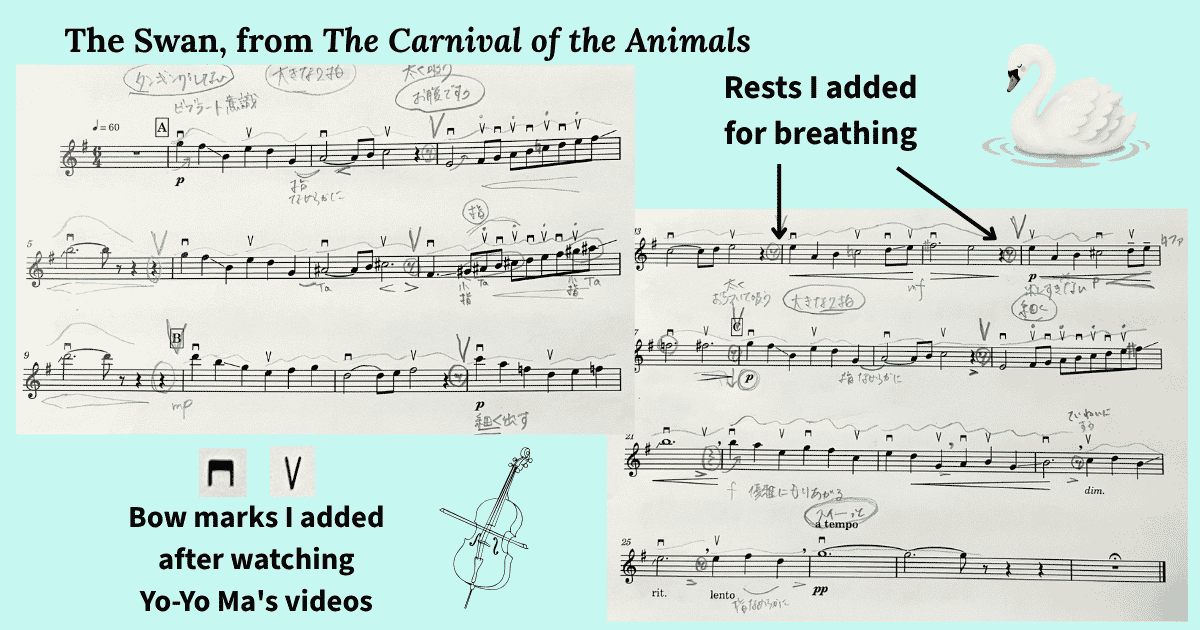
On the score, I added down-bow and up-bow marks myself after watching Yo-Yo Ma's performance videos. These marks show which direction the bow moves.
Extra Practice for Playing the Whole Piece
Long tones with a crescendo and a decrescendo
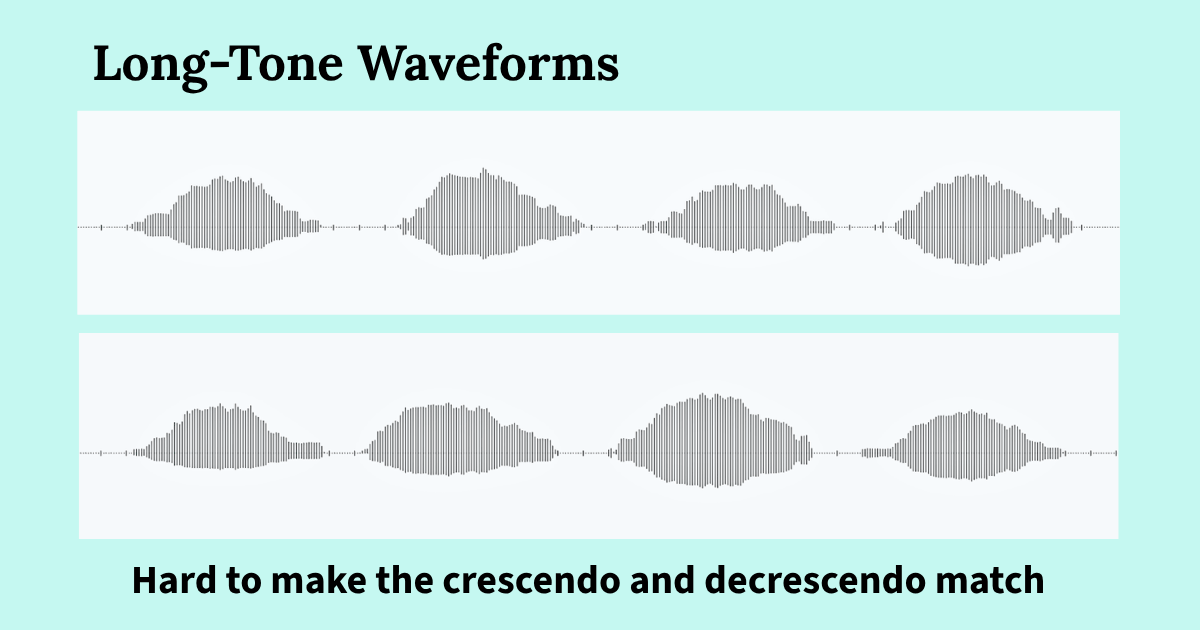
At 60 beats per minute, I practiced long tones: four beats getting louder (crescendo), then four beats getting softer (decrescendo). I recorded them and checked the waveform and the volume.
The crescendo went smoothly. But in the decrescendo, the volume dropped suddenly, and I could not make it smooth. The decrescendo was the harder of the two.
Feeling two big beats
"The Swan" is in 6/4 time, which has six beats in each measure. I played while feeling each measure as two big beats, instead of six. When I did this, I was able to play with a flowing rhythm.
What Was Difficult
- Every note needed very fine control. I had to combine starting the note with dynamics within the note, and ending the note with dynamics within the note.
- When starting a note from silence, it was hard to make the smallest sound possible.
- In a real cello performance, the sound almost never breaks. So in some places, my breath did not last.
In those places, I breathed at points where a break in the phrase would still sound natural.
But when I focused on keeping the sound unbroken, I lost the chance to breathe.
So I added quarter rests and eighth rests to the score myself, at the ends of phrases. I created these rests on purpose, so that I could play steadily to the end of the piece.
This made it much easier to play.
Recordings I Listened To
To prepare, I listened to "The Swan" played by many different performers on Apple Music, and used them as references.
For example, Mari Endo, a Japanese cellist, gives an open, flowing, and elegant performance. Yo-Yo Ma's performance shows the skill of a true master. Each performer gives me a different image of the swan.
Even in the same piece, each performer's personality sounds so different. That surprised me.
My Settings and Recording Setup
From here, I cover the settings and recording setup I used for this performance, and how I made the accompaniment.
Aerophone Settings
- Model: AE-20
- Sound: Cello Vib (P07-04)
- Key: C (no transposition)
- Breath Curve: L3
- Breath Adjust: 20
- Effects: Reverb Level 75 (the default is 82)
In my previous article, I recorded with no effects (a dry sound). I always practice with a dry sound, too.
This is because if I practice with effects from the start, I cannot tell whether the fine details of my expression are really there.
For this recording, I waited until I felt my playing was good enough to record. Then I added effects little by little and adjusted the value.
Recording Setup
- Audio interface: GO:MIXER PRO-X
- Computer: Windows PC
- Recording software: Windows Sound Recorder
- Playing the backing track: Anytune Pro+ on my smartphone
For the accompaniment, I made a backing track in Cubase (music production software) and exported it as an MP3. I played it with Anytune Pro+, a music practice app, on my smartphone. My smartphone was connected to the Aerophone by Bluetooth.
I recorded by connecting the Aerophone's PHONES jack to the LINE input on the GO:MIXER PRO-X with a cable. Roland makes the GO:MIXER PRO-X for smartphones and does not officially support using it with a PC.
Roland GO:MIXER PRO-X
See full specs and details on the official page:
Roland GO:MIXER PRO-X — Official Product Page
The Score, the Backing Track, and Copyright
Before posting a performance with accompaniment on my blog, I researched copyright. I am not a legal expert, and copyright laws differ by country. From what I found in Japan, there were three things to be careful about.
- The piece itself: Saint-Saëns died in 1921, and the copyright on his music has expired.
- Backing tracks from commercial CDs: Even when the copyright on the piece has expired, the people who performed it and the company that made the CD have their own separate rights. So you cannot post the sound of a backing track CD on a blog without permission.
- Arrangements: If someone rewrote the accompaniment based on the original, the arranger may have rights to that version.
So I decided to make the accompaniment myself, entering the notes from the composer's own score.
- The score I used: The version for cello and piano by Saint-Saëns himself (Paris: Durand & Schoenewerk, 1887), on IMSLP, a website that shares public domain sheet music for free. Its copyright field says "Public Domain."
- The score I played on the Aerophone: The cello part in the original is written in C clef. To make it easier to read, I changed it to treble clef and re-entered it in Dorico, a music notation program.
- The backing track: I made it myself in Cubase Pro 15, based on the piano part of the score above. For the dynamics, I listened to several real cello and piano performances for reference, and added them myself.
Summary
This time, I practiced "The Swan" by Saint-Saëns with one goal: to sound like someone playing a cello.
I saw clearly that breath control is directly connected to expression.
- To sound like a string instrument, I focused on starting the note, ending the note, and dynamics within a note
- To play the whole piece, I added long tones with a crescendo and a decrescendo, and practiced feeling two big beats
- Where my breath did not last, I created rests on purpose at the ends of phrases
- I made the backing track myself in Cubase, based on the composer's own score
I want to keep playing the Aerophone and enjoying it.
My 100th Article
With this article, my blog has reached exactly 100 articles. I write in Japanese first, and most of the articles on this English site are translations.
I have posted parts of pieces before, but this is the first time I have posted a whole piece with accompaniment.
Partly because of copyright, I had not been able to post one until now. I am deeply moved that I could share a performance at this milestone.
Knowing that you read my articles always encourages me.
I will keep writing articles full of my love for the Aerophone.