Choosing a Chair for Aerophone Practice: Why I Use a Drum Throne
🌐 Read this article in Japanese(この記事を日本語で読む)
Hi, I'm Shuko.
I started playing the Aerophone in 2022, with no wind instrument experience.
In an earlier article, I explained the basic posture for practicing on a chair. In this article, I write about the chair itself. I practice on a drum chair. Its proper name is a drum throne (a chair made for drummers).
When you work at a desk, the chair you use changes how much strain your body feels. The chair matters just as much when you practice an instrument. A different chair can reduce the strain on your body and make long practice sessions more comfortable.
Do you ever feel like this when you practice?
- "My body does not feel steady on this chair."
- "My bottom starts to hurt, and I cannot concentrate."
If so, changing your chair may help.
In this article, I explain three points to check in a practice chair, review the drum throne I use, and compare it with other chairs I have tried.
I hope this helps you find a chair that suits your body.
Contents
3 Points to Check in a Practice Chair
Most people sit on a chair when they practice the Aerophone or another instrument at home. What kind of chair makes playing more comfortable? I check three points.
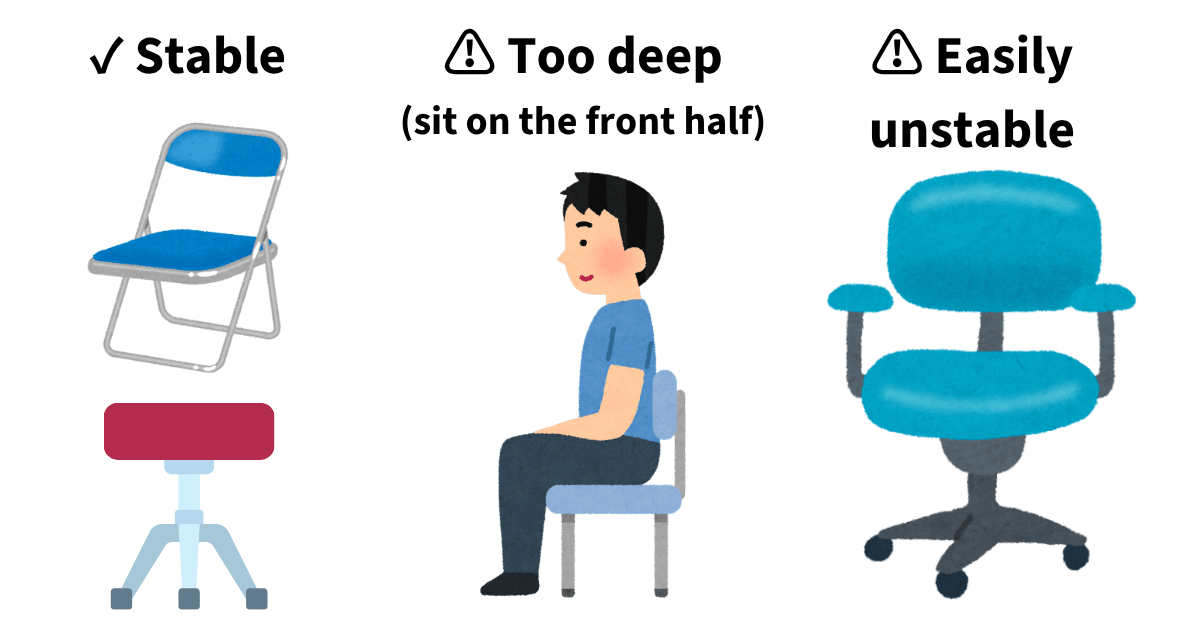
- Stable: the chair does not move while you play.
- Adjustable: you can set the height so that both feet are flat on the floor.
- Cushioned: your bottom does not hurt, even after a long time on the front half of the seat.
Stable: The Chair Does Not Move
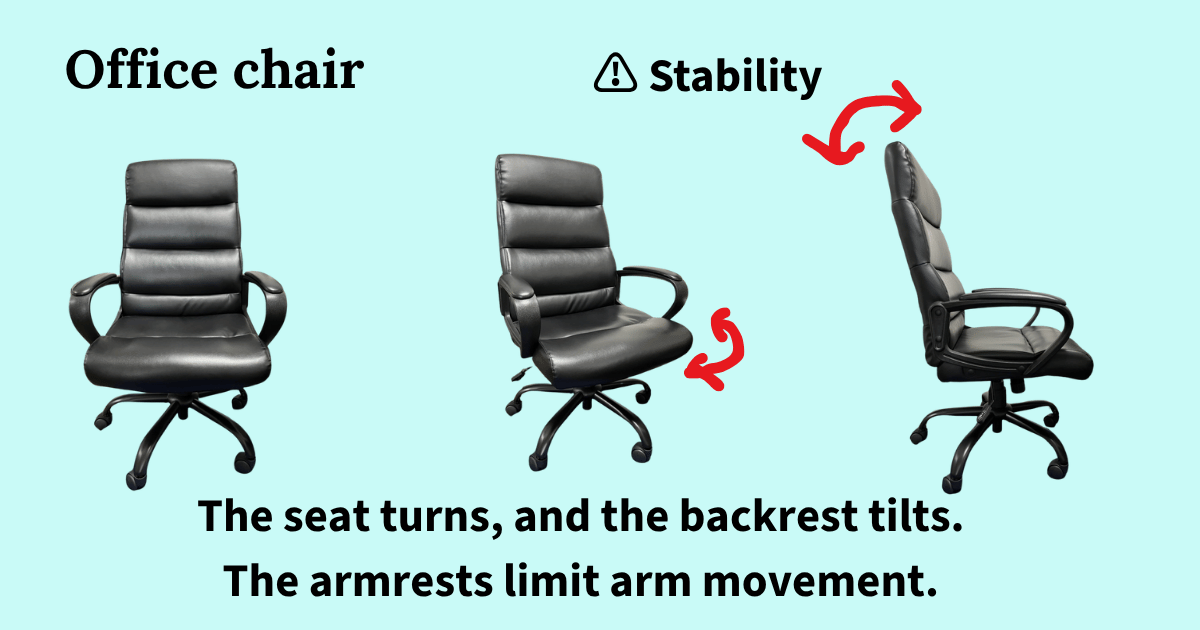
Many office chairs have a seat that turns. On a seat that turns, your body often does not feel steady while you play.
Wheels are another point to check. If a chair with wheels is too light, it rolls when your body moves.
Adjustable: Both Feet Flat on the Floor
The base of a stable playing posture is to keep both feet flat on the floor. So I recommend a chair with a height you can adjust in small steps to fit your body.
A good guide is a knee angle of about 90 degrees, or a little wider.
If the chair is too high, your feet do not rest firmly on the floor, and your body becomes unsteady. If it is too low, you lean forward, and this can lead to lower back pain.
Cushioned: No Pain After a Long Session
When you play, sitting on the front half of the seat keeps your posture stable.
But this puts your weight on a small area of your bottom. On a hard seat, you may not notice it when you use the whole seat. When you sit on the front half, it soon starts to hurt.
A seat with good cushioning makes playing much more comfortable.
What Is a Drum Throne?
A drum throne is the chair that drummers sit on. It is also called a drum stool. "Throne" is the English word for a king's or queen's chair.
It is made for drummers, so it is more stable than an ordinary chair.
I first learned about drum thrones at my music school. There was one in the lesson room.
At home, I was practicing on an office chair. The seat moved, and I did not feel steady. When I sat on the drum throne during lessons, my body felt stable, and the Aerophone was easier to play. So I decided to buy one.
My Drum Throne: The Pearl Roadster D-1500S
There are many kinds of drum thrones. This is the one I chose:
- Model: Pearl Roadster D-1500S (short model)
- Maker: Pearl, a Japanese company known for drums and percussion, and also for flutes
Pearl — D-1500S Drum Throne (official page)
Some stores write the model name as "D1500S".
I chose it for two reasons: the seat can be set low, and the cushion is thick.
Before I bought it, I measured my office chair at the height where I played most comfortably. The seat was 44 cm (17.3 in) above the floor. So I looked for a drum throne with a low setting and a good cushion, and I found the D-1500S.
The seat height of the D-1500S adjusts from 44.5 cm to 61.5 cm (17.5 to 24.2 in). The standard model, the D-1500, starts at 49.5 cm (19.5 in). I decided that would be too high for me.
I am 154 cm (5 ft 1 in) tall, and I use it at the lowest height. If you are also not tall, a short model with a low setting is a safe choice.
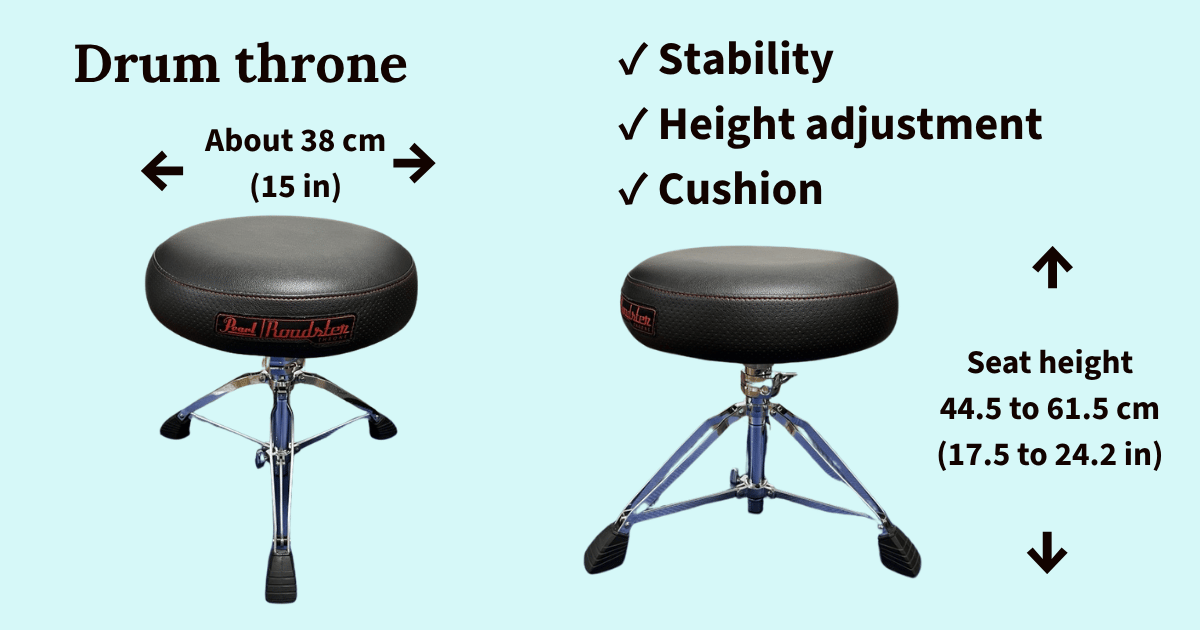
The round seat is about 38 cm (15 in) across. It takes more space in a room than I expected. But it is very comfortable to sit on. The seat is thick and firm. In my case, my bottom does not hurt, even after a long practice session.
The center of the seat is slightly lower than the edge. This spreads my weight, and I can keep my posture. With a stable posture, I also feel much less strain on my lower back.
The seat can be set to turn freely or to stay fixed. I use it fixed. It turns if I push it with force, but it does not move with small movements of my body.
On an office chair, I tend to lean on the backrest, and I stop sitting straight. My drum throne is different. It has no backrest. When the height is right, my back straightens naturally as I sit down.
I have also tried it for guitar practice and for typing at my computer. It suited both.
How to Sit on a Drum Throne
Here is how I sit on a drum throne when I practice the Aerophone:
- Depth: I sit on the front half of the seat, not at the back.
- Feet: I set the height so that both feet are flat on the floor.
- Knees: I keep them at about 90 degrees, or a little wider. If the seat is too low, I lean forward.
- Legs: I open my knees slightly outward. This makes my lower body more stable.
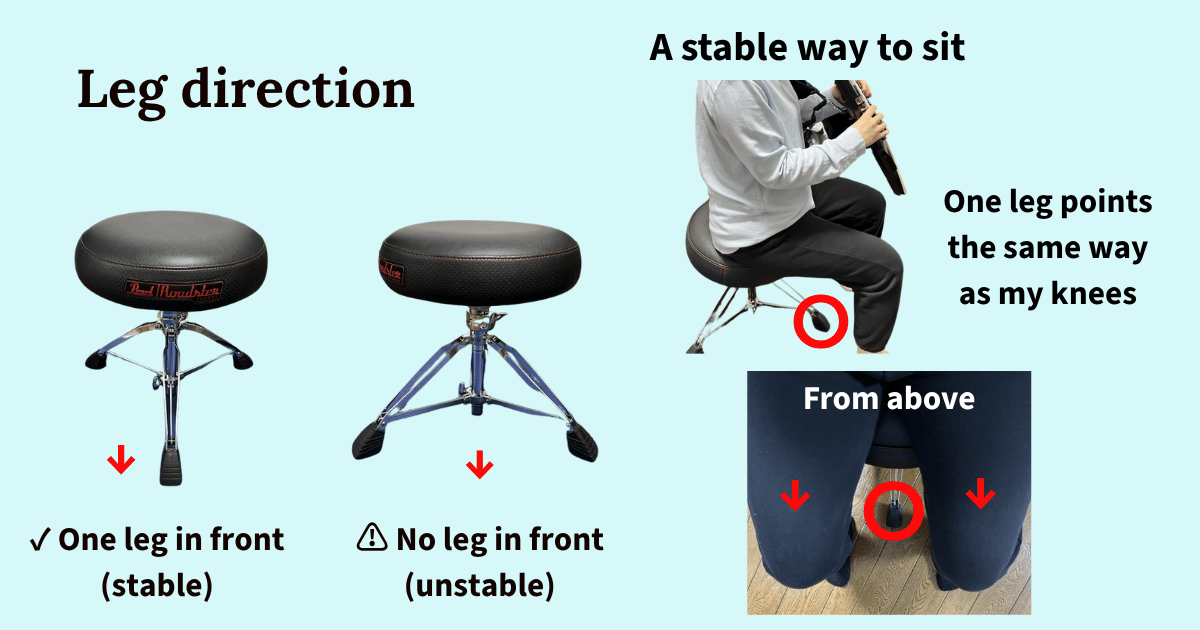
My drum throne stands on three legs, and their direction also matters.
I turn the throne so that one leg points straight forward, in the same direction as my knees.
When I sit on the front half, my weight moves forward. Without a leg in front, the throne can tilt forward or wobble. With one leg in front, it does not tilt.
Roland Aerophone AE-20
See full specs and details on the official page:
Roland Aerophone AE-20 — Official Product Page
Compared with Other Chairs I Have Tried
I have practiced on several kinds of chairs. This table shows how each one felt to me for playing. These are my own impressions.
| Chair | Stability | Height adjustment | Cushion |
|---|---|---|---|
| Drum throne | Very good | Very good | Very good |
| Office chair | Limited | Good | Good |
| Wooden stool | Good | None | Poor |
| Piano bench | Good | Good | Very good |
| Folding chair | Good | None | Limited |
Here is more about each chair.
Office Chair
When I started, I practiced on an office chair with wheels. The height was easy to adjust, and the seat had a cushion.
The chair was heavy, so the wheels did not roll by themselves. But the seat turned left and right, so my body was never fully steady. Without noticing, I was using extra force in my legs and lower back.
The backrest also tilted, and the armrests limited the movement of my arms a little.
I also felt that a light office chair could tip forward when I put my weight on the front half.
Wooden Stool
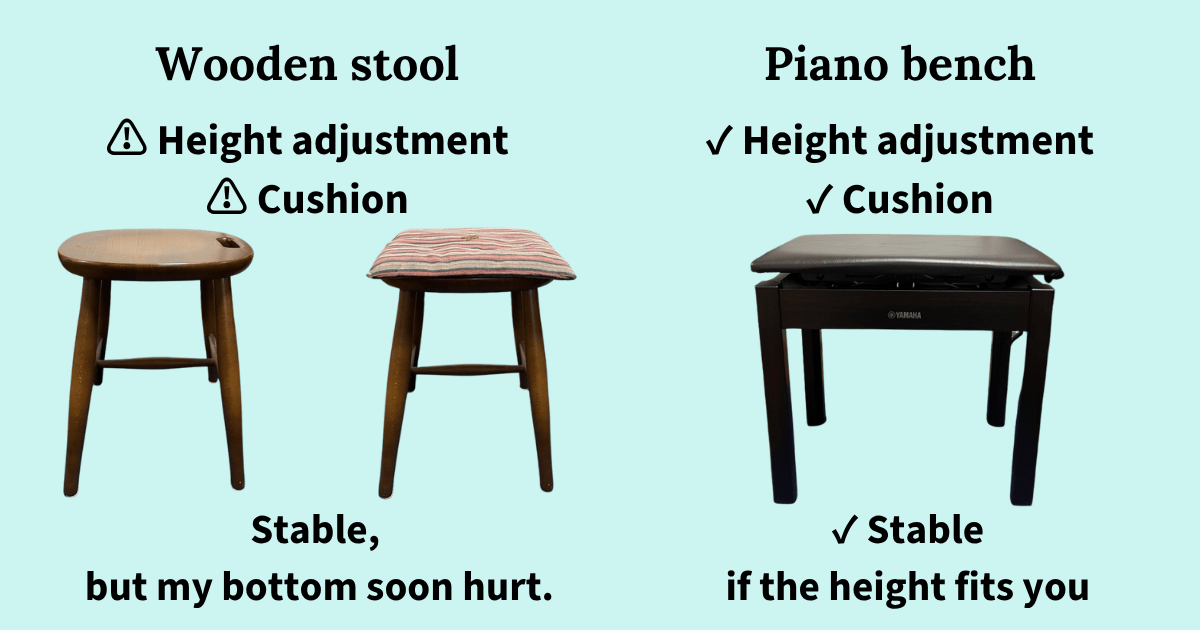
I also tried a plain wooden stool. The height was right for me. But the seat was hard and had no cushion, so long practice was difficult.
When I sat on the whole seat, I could bear it. When I sat on the front half, as I do for playing, my bottom hurt a lot. I put a thin cushion on the seat, but about 15 minutes was my limit.
Piano Bench
A piano bench is stable, and the cushion is very good. But the seat was too high for my height.
Playing on it reminded me that a piano bench is made for playing the piano.
The feeling is hard to describe. When I sat on the front half, my weight seemed to move slightly forward. I think a piano bench is designed this way, so that the player can reach the keys and use the pedals easily. The height may also be part of the reason.
Folding Chair
Folding chairs are common in public practice rooms, lesson rooms, and small concerts.
They fold flat and are easy to store, and they are stable.
But the height is fixed, so it does not fit everyone. Also, when I sit on the front half of a folding chair, I tend to lean forward. So I pay attention to my posture when I use one.
Summary
In this article, I wrote about the drum throne, the chair I use for practicing the Aerophone at home.
These are the three points I check in a practice chair:
- Stable: the chair does not move while you play.
- Adjustable: you can set the height so that both feet are flat on the floor.
- Cushioned: your bottom does not hurt, even after a long time on the front half of the seat.
My drum throne gave me all three.
Drum thrones come in many types. The number of legs, the seat shape (round or saddle-shaped), the seat size, and the cushion thickness all differ. The height adjustment also differs: some models use a screw, and others use a gas lift.
Large music stores and drum shops often have drum thrones on display. If you are interested, I suggest you sit on one in a store.
For me, the stable seat and the cushion made a big difference.

I hope you find a chair that makes your practice more comfortable, wherever in the world you are.
Where I Am Now (November 2026)
I bought my D-1500S in April 2023 and wrote the Japanese version of this article in April 2024. I still practice on the same drum throne today, and I have not changed the height. I have now used it for more than three years.