Aerophone Playing Posture, Part 1: How to Sit and Adjust Your Strap
🌐 Read this article in Japanese(この記事を日本語で読む)
Hi, I'm Shuko.
Do you get a stiff neck, sore shoulders, or a painful thumb when you practice the Aerophone?
You started the Aerophone to enjoy it. It is discouraging when body pain makes practice hard.
A good strap helps, of course. But even a simple change in your playing posture can make a big difference. You get tired more slowly, and pain appears less often.
In this article, I share the posture tips I found through trial and error while taking lessons. These tips help me play longer with less fatigue and less pain.
It is a long topic, so I have split it into two parts. This is Part 1.
The best posture also depends on your body type. Please read this as one example from a player who is 154 cm (5 ft 1 in) tall.
This article is a record of what I worked out during my first two years with the Aerophone, from 2022 to spring 2024.
Contents
The Aerophone Was Harder Than I Expected
I bought the Aerophone to enjoy my time at home during the pandemic. Before that, the only wind instrument I had ever played was the recorder in elementary school.
I was starting from zero, with no knowledge at all.
Blowing into it made a sound easily. But once I started practicing, my neck and thumb began to hurt. Air leaked from the corners of my mouth, and my lips hurt too.
Everyone on YouTube plays it so easily. This is much harder than I expected!
That was a real shock for me.
I searched the internet for saxophone techniques, but I could not fix the problems by myself. There was a period when I lost motivation.
What saved me was my teacher's advice at my lessons. I learned the key points from a professional, kept adjusting through trial and error, and the pain became far less than when I started. Now I can practice longer, and I can feel myself improving.
I hope this article gives some hints to players who study alone with no one to ask, and to anyone who has noticed more body pain lately.
Playing While Seated
When you practice at home, you probably play while seated. I also practice seated most of the time, except right before a recital.
Let's start with the basics of sitting posture.
How to sit on the chair
You may think, "It's just a chair." But for playing an instrument, the chair matters a lot. Here are the points I pay attention to.
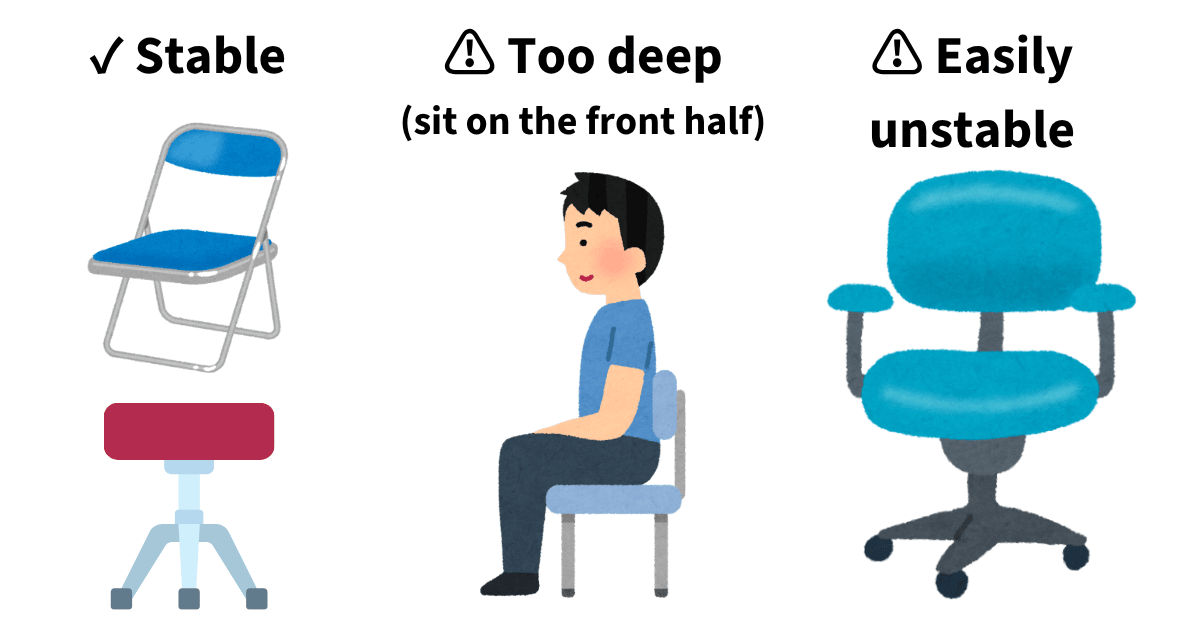
- Sit shallow: sit on the front half of the seat.
- Feet: adjust the height so both feet rest flat on the floor. This keeps your body stable.
- Knees: aim for an angle of about 90 degrees. If the seat is too low, you tend to lean forward.
- Legs: open your knees slightly. This makes your lower body more stable.
The type of chair you use also matters.
- A typical office chair has a seat that rotates. This makes your posture unstable while you play.
- Casters are fine if the chair is not too light. But armrests tend to get in the way.
- Choose a chair with some cushioning. Your practice will be more comfortable during long sessions.
At first, I used an office chair I had at home. When I sat on the front half of the seat, it wobbled and never felt stable. That is how I found the drum chair.
A drum throne (a chair made for drummers) is extremely stable and comfortable to play on. I still use one today.
Keeping your posture
Once you are seated, straighten your back gently. Here are my tips for staying relaxed.
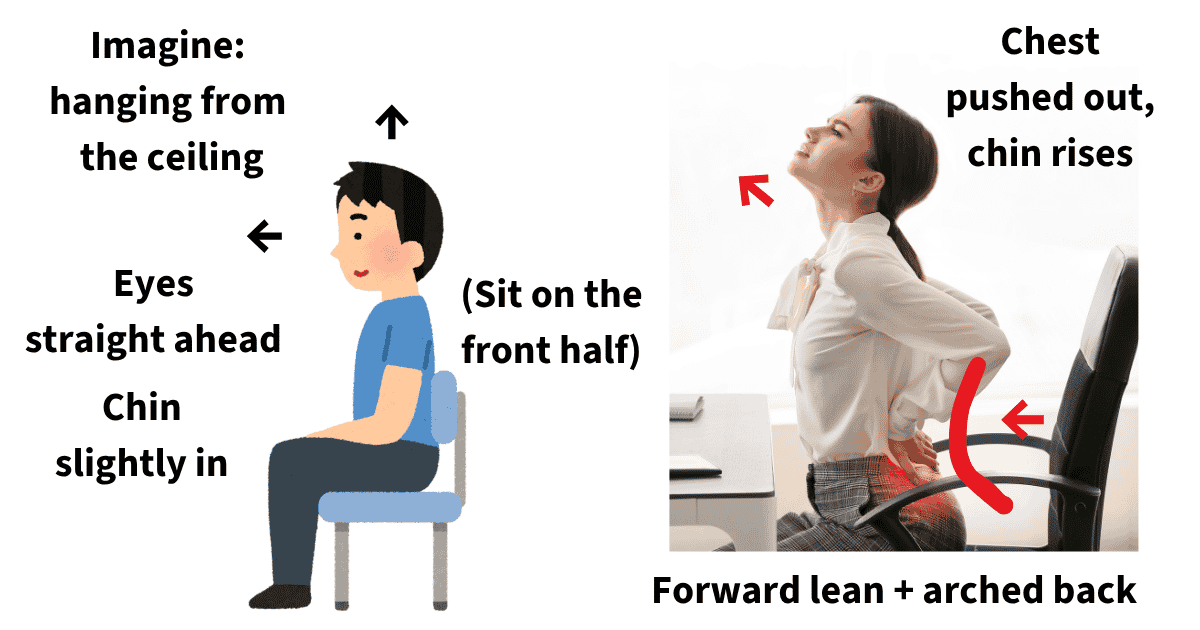
- Imagine the top of your head hanging from the ceiling, like a keychain. This image helps you release extra tension.
- Do not try too hard to straighten your back. It can make your lower back arch, and that can lead to back pain.
- When you try to face forward, your chin often rises without you noticing.
- Do not pull your chin in too far, either. The best angle is natural, as if you were gazing softly into the distance.
"Stay relaxed and hold the instrument naturally" is easy to say, but hard to keep doing. When you focus on practice, your posture slowly collapses. You lean forward, your back rounds, and your shoulders tense.
Be careful when you look closely at your sheet music. This is when you tend to lean forward or arch your lower back. If you push your chest out too much, your chin rises.
I recommend checking your face angle in a mirror from time to time, and taking short breaks often.
Adjusting your strap length
Sit correctly and straighten your back. Then, without changing your posture or the angle of your face, adjust the strap length so that the mouthpiece comes naturally to your mouth.
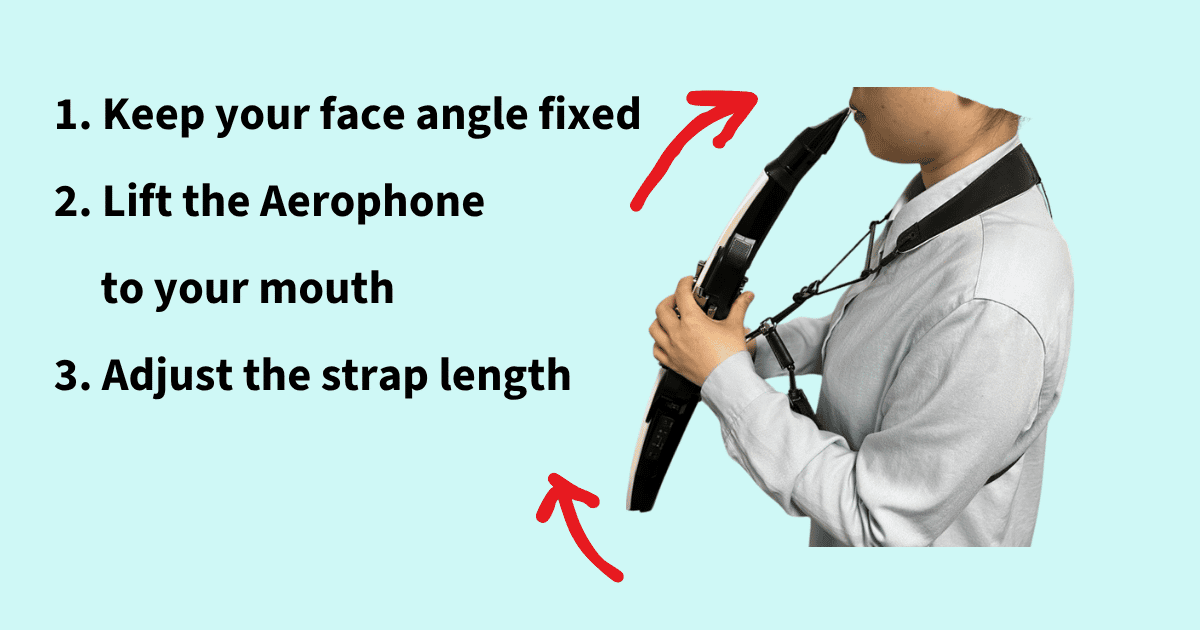
If you move your face toward the mouthpiece, you lose the good posture you just built — the image of hanging from the ceiling. This leads to tension and fatigue through your whole body.
Facing slightly downward is fine, but avoid tilting your head too far up or down. In my case, when I face down too much, I bite my lower lip hard. When I face up too much, my shoulders tense and my arms tire quickly.
Also, adjust your music stand to a height where you can see the whole score by moving only your eyes. This makes it easier to keep good form. I recommend setting it slightly low.
Once the mouthpiece is in your mouth, release the tension in your shoulders and let the strap carry the full weight of the instrument.
My Posture, Then and Now
For about the first six months with the Aerophone, I did not understand why the strap mattered. I thought it was just a cord to stop the instrument from falling. So I practiced with the bottom of the instrument resting on the chair.
Recently, I recreated my old posture for the photo below. It shows every single "don't" I have talked about in this article. Honestly, it shocked me.
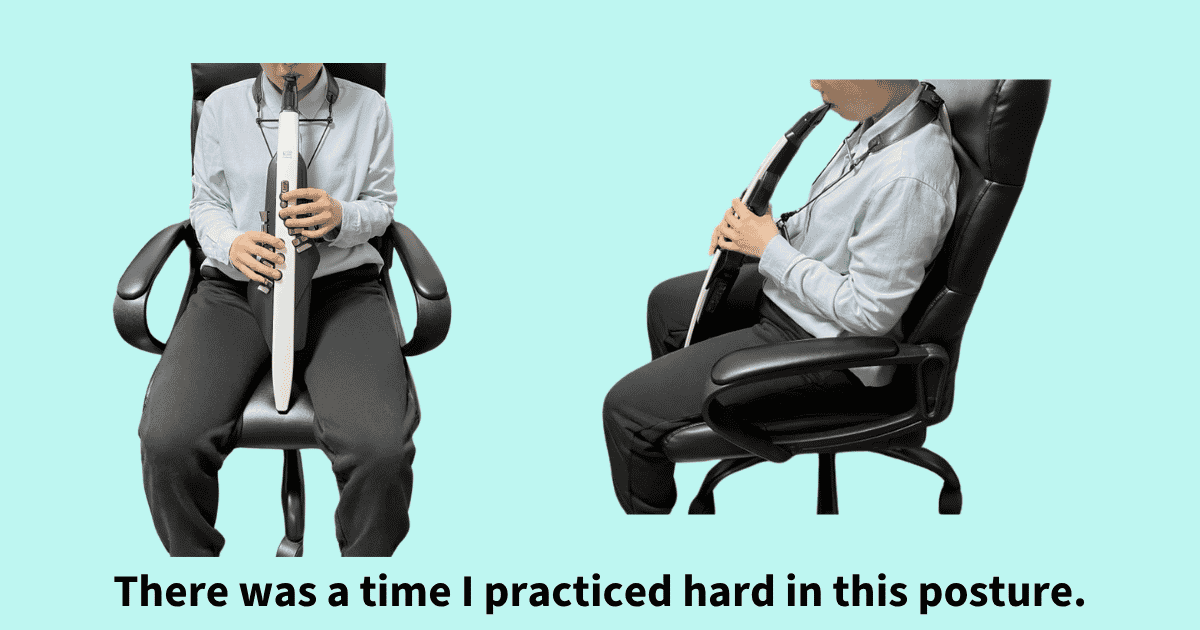
- Sitting deep in the chair, with all my weight against the backrest
- Back fully rounded, eyes looking too far down
- Pushing my face forward to reach the mouthpiece
- Strap completely slack, doing nothing at all
At the time, this was the result of a desperate search for the posture that hurt my neck and thumb the least. It was how I kept my motivation going.
I could play like this at home. But at lessons and recitals, I had to play standing, and my neck and thumb hurt. I had a feeling that something was fundamentally wrong.
From there, I got advice from my teacher and kept adjusting, step by step, for about a year. Here is my posture after that work.
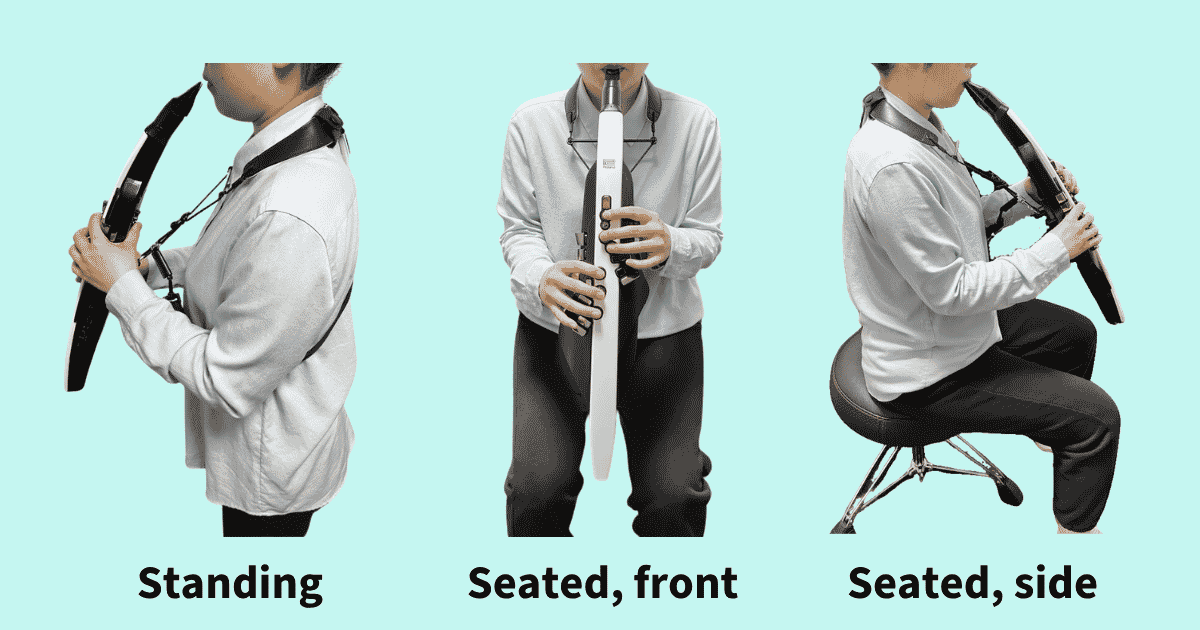
I do not think my old way was 100% wrong. It helped me continue during that period.
But for improving without straining my body, my current posture is without question the right answer.
I will keep aiming for a natural posture that puts as little strain on the body as possible.
Roland Aerophone AE-20
See full specs and details on the official page:
Roland Aerophone AE-20 — Official Product Page
Summary
In this article, I broke down Aerophone playing posture into small parts. Part 1 covered how to sit, how to straighten your back, and how to position your strap.
- Sit on the front half of the chair, with both feet flat on the floor, so your lower body stays stable.
- Straighten your back naturally, as if hanging from the ceiling. Watch out for leaning forward and for the angle of your chin.
- When you take the mouthpiece, do not move your face. Bring the Aerophone to your mouth, then fix the strap length there.
After I corrected my posture, my body pain dropped greatly, and I could practice longer.
Improving your form does not happen in a day. The key is to keep paying attention to it, little by little, in your daily practice, without rushing.
One day, you will suddenly notice, "Playing feels easier than usual!"
The best form depends on your body. I hope this article helps you find a posture that lets you play with your body relaxed.
Two years on from where this record ends
I wrote the original version of this article in April 2024. My posture has stayed the same since then, and the neck and thumb pain has not come back. The drum throne is still my practice chair today.