Roland Aerophone Brisa Hands-On Review: A Flute-Style Wind Synth Even Beginners Can Play
🌐 Read this article in Japanese(この記事を日本語で読む)
Hi, I'm Shuko — a music blogger from Japan.
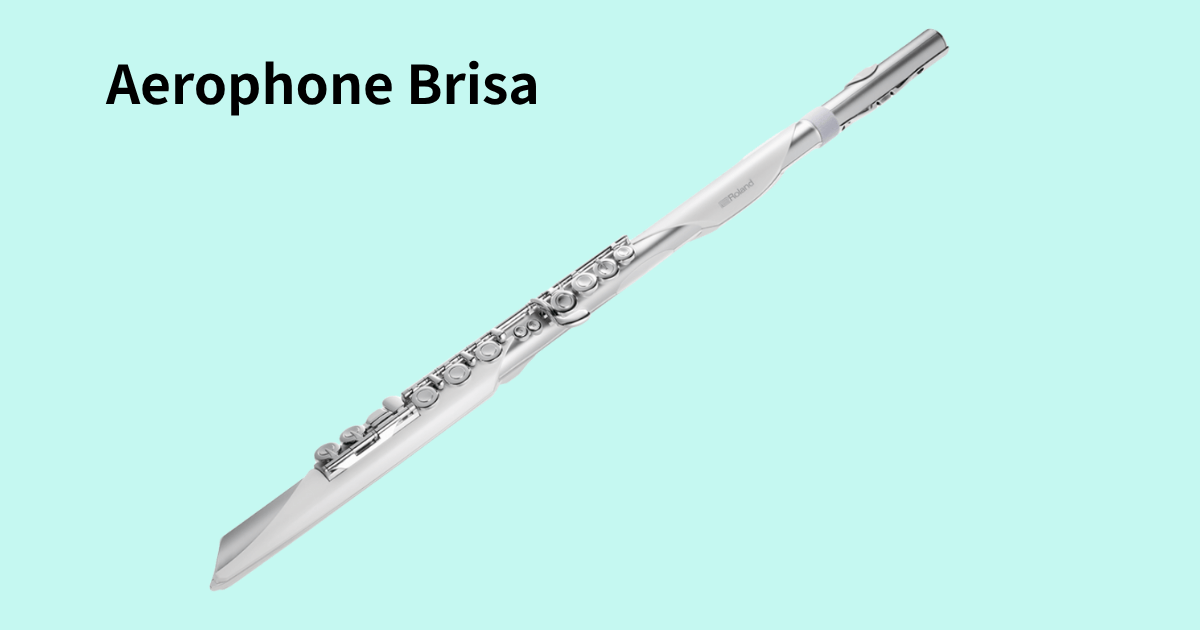
In September 2025, Roland announced a brand-new member of the Aerophone family: the Aerophone Brisa, a flute-style digital wind instrument.

It looks exactly like a flute — love at first sight. So beautiful!
Maybe you've admired the flute for years but wondered, "Could someone with zero experience really play it?" On an acoustic flute, just producing a sound is famously difficult, and that first hurdle stops a lot of people from ever starting.
The Brisa was exhibited at a music expo held in Tokyo on November 1–2, 2025, and I got to try it in person.
My honest impression: this is an instrument a complete flute beginner can genuinely enjoy. In this article, I'll share everything I noticed — the weight, the fingering, the sound quality, and more, in the order of the table of contents below.
* This page may contain affiliate links.
Contents
What Does "Brisa" Mean?
When a new instrument appears, don't you wonder where its name comes from? Let's start there.
"Brisa" is the Spanish word for a gentle breeze.
It's a light, airy name that fits the instrument perfectly — the elegant flute-like silhouette, and the kind of sound that shape brings to mind.
Behind the name is a clear message: this instrument is meant not only for flutists and experienced players, but for people who have never touched a wind instrument at all.
How It Looks When You Play It
Part of the flute's appeal is that graceful sideways posture, isn't it? So what happens when a total beginner picks one up? See for yourself.
I have never played a flute in my life. Here I am, holding a flute(-shaped digital instrument) for the very first time.
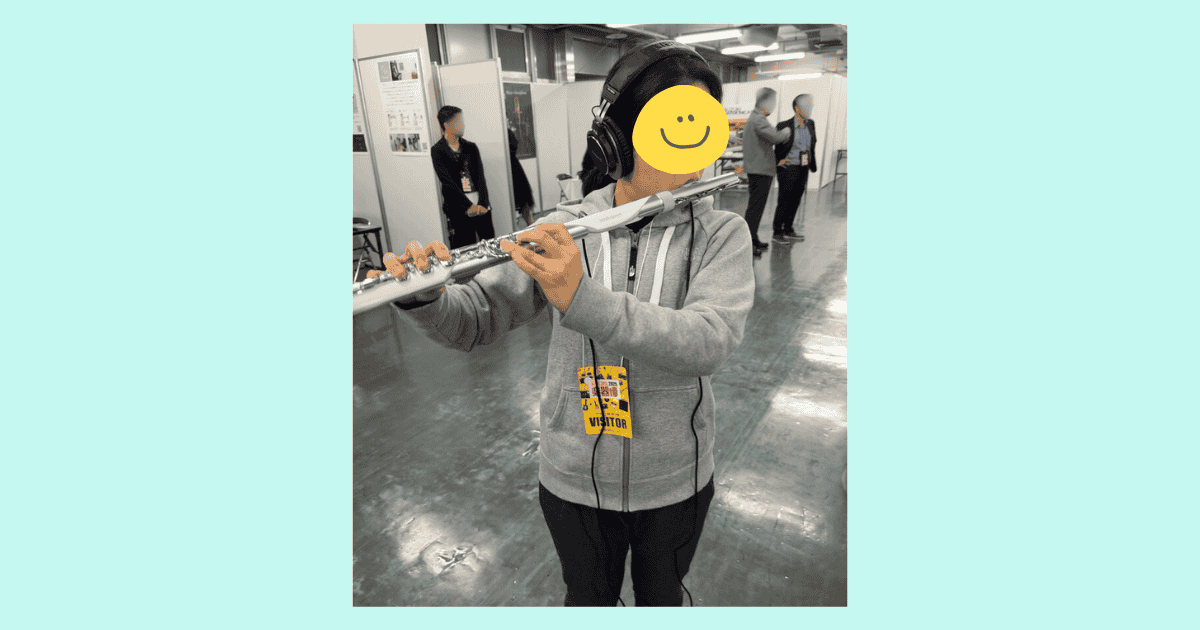
Not bad for a first-timer, right?
The Weight: Astonishingly Light
If you're going to practice for long stretches, weight matters a lot.
The moment I held the Brisa, the first thing I felt was: this is far, far lighter than I imagined.
The body weighs just 415 g (about 0.9 lb) — even lighter than the Aerophone mini (AE-01) at 500 g including batteries. That genuinely shocked me.
Looking at the long 752 mm body, you would never guess it. It's hard to believe a rechargeable battery and all that electronics fit inside something this light.
Size and feel
The Brisa is 752 mm (29.6 in) long and 51–52 mm (about 2 in) thick.
The entire Aerophone lineup was on display at the expo, so I compared their sizes side by side.
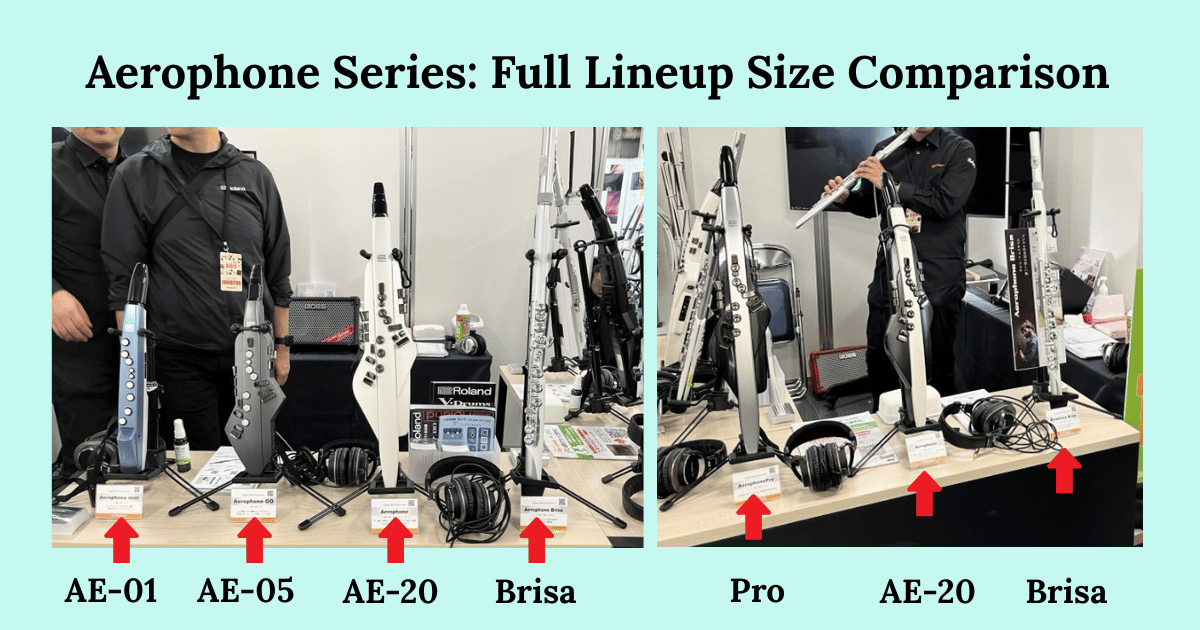
- The Brisa is slim and long (752 mm)
- It's noticeably longer than the AE-20 (632 mm)
- The Pro is bigger than you'd expect (683 mm)
| Model | Weight (incl. batteries) |
|---|---|
| Aerophone mini (AE-01) | 500 g |
| Aerophone GO (AE-05) | 695 g |
| Aerophone (AE-20) | 1,100 g |
| Aerophone Pro (AE-30) | 1,140 g |
| Aerophone Brisa (AE-Brisa) | 415 g |
Roland Aerophone Brisa
See full specs and details on the official page:
Roland Aerophone Brisa — Official Product Page
How You Play It
"But I don't know flute fingering at all — is that a problem?" Don't worry. There's a very welcome surprise here for Aerophone players.
Fingering
Before the expo, I thought I'd better study flute fingering in advance. It turned out I didn't need to.
The Brisa has something wonderful for Aerophone users: Brisa mode.
Brisa mode uses a recorder-like fingering that largely carries over from the regular Aerophone fingering, so it feels familiar right away and the entry barrier is low.
And of course, the Brisa fully supports standard flute fingering too — so flutists, you're covered as well!
The mouthpiece
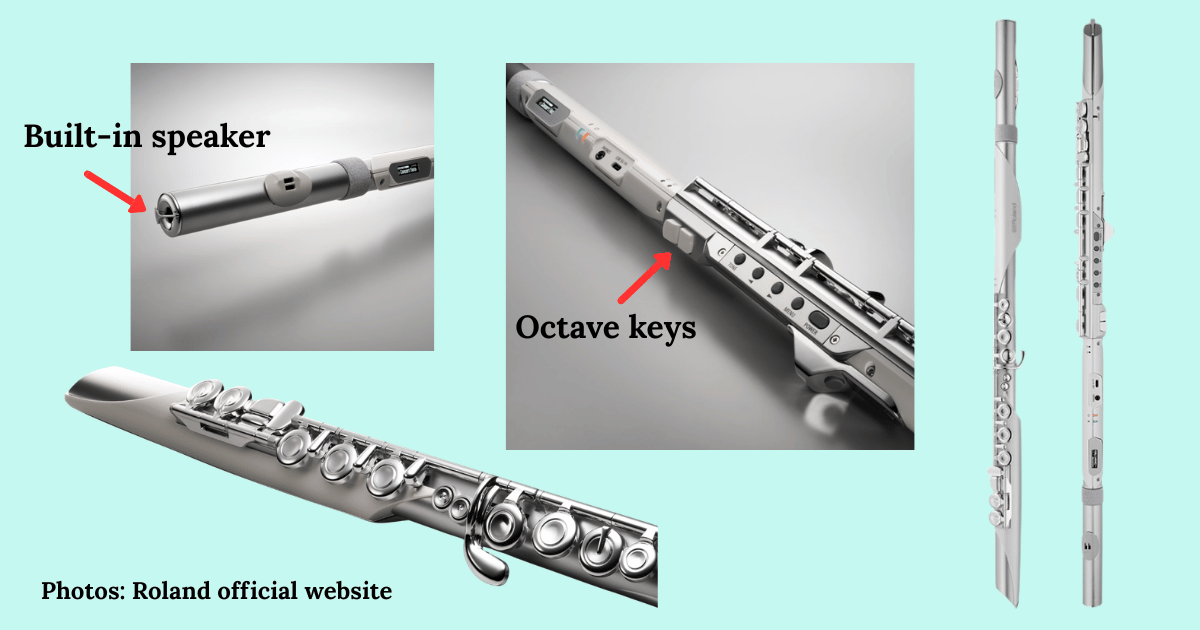
The Brisa has two blowing holes. You cover both with your lips and blow into them to produce a sound.
Just like the other Aerophones, even the gentlest breath is enough to make a sound.
In Brisa mode, you switch octaves with the octave keys.
In flute mode, you change octaves by directing your breath between the two blowing holes instead.
Sound Quality
With any digital instrument, the biggest question is always the sound. Let me tell you what it felt like the moment I played it.
Headphones or an amp bring out the best
I put on headphones and blew gently into the Brisa — and the thrill was equal to, maybe even greater than, the first time I ever played my Aerophone AE-20.
The sound pulled me into the Brisa's world instantly. I got completely absorbed and didn't want to stop playing. It's that kind of sound.
One technical difference: the breath sensor in the previous Aerophone models detects air pressure, but the Brisa's sensor detects the flow and force of your breath instead.
I had the impression that every nuance of my breath was reflected directly in the sound I heard.
Inside is SuperNATURAL Winds, a newly developed sound engine.
Headphones for practice, an amp for playing to an audience — that's how you'll experience the Brisa's sound at its very best.
The built-in speaker
The Brisa has a built-in speaker on the left side of the body, so you can monitor your own playing.
However, just like the other Aerophone models, it's not a speaker meant for performing to other people.
The expo floor was quite noisy, so it was hard to judge the exact volume and quality — but even in that noise, the speaker was loud enough for me, the player, to hear myself.
I suspect the sound might distort if you push the volume too high, so I'd treat it strictly as a monitor.
Other Things I Noticed
I could go on about the Brisa forever, but here are a few more things I noticed.
Breath noise
When you blow into the Brisa's mouthpiece, the air exits through a vent on the other end of the body.
That means you can hear the sound of your breath near the instrument — a difference from the previous Aerophone models.
With headphones on, I didn't notice it at all. And if an amp is playing at a decent volume, I don't think it would bother anyone.

In a quiet room, someone standing within a meter or two of the player can hear the breath sound.
Key feel
If you're a flutist, you're probably curious how the Brisa's keys feel.
I've never played an acoustic flute, so I can't make a direct comparison. What I can say is that nothing felt unnatural — no rattling, no plasticky clicking.
Other handy features
- USB rechargeable — about 8 hours of playing per charge
- 100 built-in sounds
- Transpose function, of course
- Adjustable effects such as reverb
- A built-in motion sensor lets you add vibrato and pitch bend with body movement
- A dedicated companion app, "Aerophone Brisa Plus"
Summary
I finally got to play the Aerophone Brisa — the instrument I'd been so curious about since the day it was announced.
Blow, and a sound simply comes out. That effortlessness is the greatest charm of a digital wind instrument.

It's hard to believe this much technology fits into such a light body!
Fingering and technique take practice on any instrument, so no, you won't play exactly what you imagine on day one. Even so, being able to enjoy the flute you've always dreamed of, right at home — that makes the Brisa a truly attractive instrument.
It's the kind of instrument that's a joy just to look at, sitting in your room — the kind that makes you want to pick it up and practice.
(As for the price: it launched in November 2025 at ¥249,700 in Japan, and at a list price of $1,759.99 in the US, €1,699 in Europe, and £1,439 in the UK — so it does call for some careful budgeting.)
If you get the chance, I really encourage you to try one at a music store or an event near you.
I later heard a professional play the Brisa at a seminar here in Japan. That report is here.