Aerophone vs. Saxophone: 4 Differences I Felt Playing Both
🌐 Read this article in Japanese(この記事を日本語で読む)
Hi, I'm Shuko.
Once you start playing the Aerophone, I think a lot of us begin to wonder: someday, I'd like to try a real acoustic saxophone too.
The Aerophone is modelled on the saxophone, so it's easy to picture the two as being much alike. In practice, though, they feel very different to play.

During a lesson, I actually got to try an alto sax and a tenor sax.
In this article, I'll tell you honestly what I noticed as a complete wind instrument beginner when I played a saxophone — and why I've stayed with the Aerophone.
If you're an experienced sax player, none of this will be news to you. I hope you'll read it kindly, as the honest surprise of a beginner.
Let me give you the conclusion first...

Similar — but completely different instruments!
The saxophone is, of course, a wonderful instrument.
But I'd love more people to know that the Aerophone is just as wonderful, with a charm entirely its own.
Feel free to jump to any section from the table of contents below.
* This page may contain affiliate links.
Contents
Why I Longed for an Acoustic Saxophone
That curiosity about the acoustic saxophone is something I think a lot of Aerophone players share.
Quite a few Aerophone players do come from the saxophone — though plenty of us arrived the other way round, with no wind instrument background at all.
For a sax player, a digital wind instrument must feel like familiar territory.
They use them to practise at home, or professional musicians bring them out for a particular moment in a performance. For those players, the digital wind instrument naturally ends up in a "secondary" role.
Seeing that kind of thing written about, there was a time when I quietly looked down on the Aerophone myself. When I first started lessons, I even thought of the saxophone as the step up I would take one day.
So I asked my teacher, and I got to try an alto sax and a tenor sax.
That lesson is the only time in my life I've held an acoustic saxophone. It made such a strong impression that I can still picture it vividly.
4 Differences I Felt Playing Both
Here's what surprised me when I actually picked up an acoustic saxophone.
What struck this beginner most about the saxophone
- The sheer weight:
About 1 kg (2.2 lb) for the Aerophone, versus 2.5–4 kg (5.5–8.8 lb) for a saxophone. The strain on the neck and shoulders is more than I imagined. - Getting a sound out:
The Aerophone sounds the moment you blow. A saxophone is a reed instrument — a different story entirely. - Holding the pitch:
The Aerophone never needs tuning. On a saxophone you have to aim for the note yourself. - Vibration and volume:
The instrument shakes, and you feel that resonance through your body.
1. The sheer weight
The first thing that surprised me was the weight. Against the Aerophone's roughly 1 kg (2.2 lb), an alto sax is around 2.5 kg (5.5 lb), and a tenor sax is 3–4 kg (6.6–8.8 lb).
The load on your neck and shoulders is on a completely different level. Playing seated is one thing, but at recitals everyone stands up to play — that alone amazed me.
2. I couldn't get a sound out
With the Aerophone, I got a sound on my very first try just by blowing. With the saxophone, nothing came out at all. The cause was how I was holding the mouthpiece — the embouchure.
The Aerophone's mouthpiece is reed-shaped, but the whole thing is plastic, so even if you bite down a little, there's still room for the air to pass through.
A saxophone reed is different. Bite down and the air passage closes completely (how the reed is set up matters too, I'm sure), and no matter how hard you blow, no sound comes out.
It was the moment I learned first-hand what a reed instrument really is: the sound is born from making the reed vibrate.
3. Not enough breath
I somehow got past the embouchure wall and started making a sound — but I couldn't send in enough air, or with enough force, to hold a steady note.
Because the Aerophone needs no tuning, this was new to me: the note I was aiming for simply wouldn't come out in tune. Getting to a good sound is a much steeper climb.
4. The vibration and the volume
I'd expected it to be loud. What I hadn't expected was the vibration travelling from the instrument into my body. It felt as though my body and the instrument had become one, and the way the tenor sax's low notes resonated so gently was especially lovely.
My own breath sets the instrument shaking, and that resonance comes back to me.
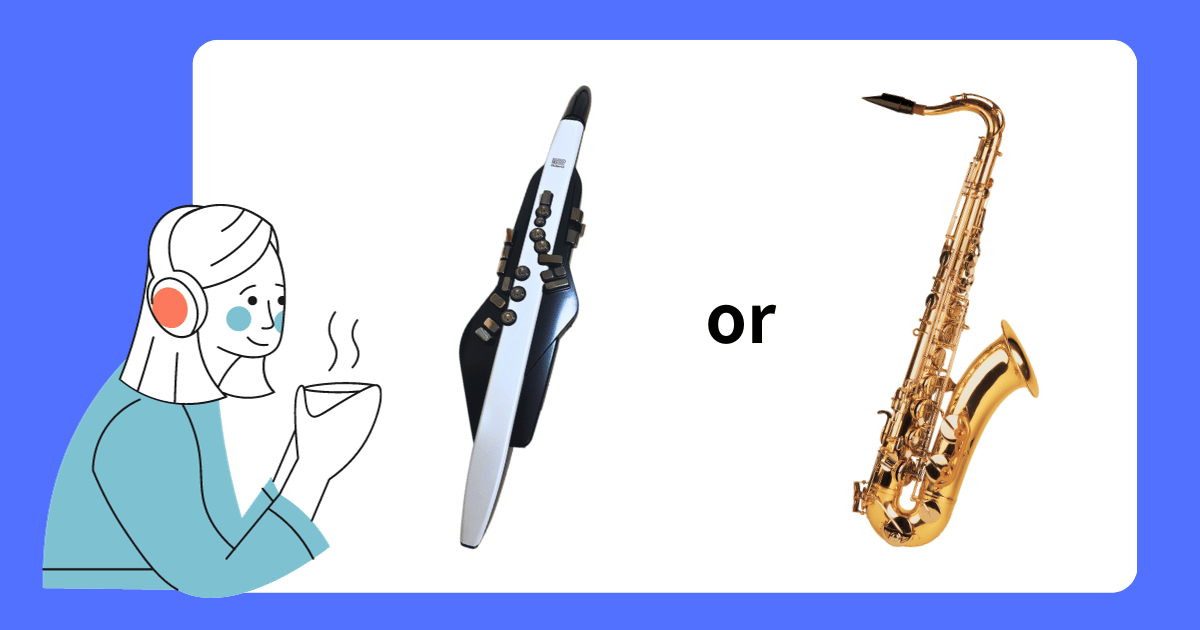
After trying both the alto and the tenor, I understood: the Aerophone is similar to the saxophone, but it is a different instrument.
Why I Stayed with the Aerophone
I'd assumed the experience would only deepen my longing for the saxophone. Instead, it made me notice how much depth the Aerophone has.
Let me tell you both sides: why I realistically gave up on the saxophone, and why I decided to keep going with the Aerophone.
Why I gave up on the saxophone
■ Too heavy for me
My shoulders get stiff even with the Aerophone, so I came to the conclusion that a saxophone would simply be too heavy for me. The strain on the neck and shoulders felt like a real obstacle to practising regularly.
■ Where to practise
A saxophone limits where you can play. I'm a homebody, and honestly a bit lazy — I needed an instrument I could pick up at home without any fuss.
Why I decided to keep playing the Aerophone
■ My teacher's sound is beautiful
When I listen to my teacher play, it's hard to believe it's the same Aerophone — the quality is on another level. My embouchure, fingering, and breathing all still have room to grow, and knowing there's that much room ahead made me want to play more beautifully.
■ Endless sounds and flexibility
Along with the tenor saxophone tone I love, you get more than 260 sounds. Transposing takes a single button, so you can play a saxophone score with a flute tone — a privilege that belongs to the Aerophone.
My slightly twisted longing — maybe the saxophone is the better choice — turned into something purer and brighter: the saxophone is wonderful!
I'll enjoy the saxophone as a listener.
Roland Aerophone AE-20
See full specs and details on the official page:
Roland Aerophone AE-20 — Official Product Page
Summary
Let me go back over what this article covered.
The Aerophone and the saxophone are similar, but they are different instruments.
If reading this made you think "the saxophone it is!" — please go for it. The saxophone truly is a marvellous instrument.
And at the same time, I want more people to know that the Aerophone is a marvellous instrument too.
If you're curious about digital wind instruments but hesitating, please try one at least once.
Digital pianos are part of everyday life now. I hope digital wind instruments get there someday too, and I'll keep writing about what makes them special — for beginners, wherever in the world you are.