4 Ways to Play Low A on the Aerophone AE-20
🌐 Read this article in Japanese(この記事を日本語で読む)
Hi, I'm Shuko — a music blogger from Japan.
The Aerophone's standard Sax fingering has a lowest note: B♭. The note one semitone below it is A, and the Sax fingering cannot play it. Many players call this note the "low A".
For most songs this never comes up. But one day it did for me.
I wanted to play "Tsuki Wo Miteita - Moongazing" by Kenshi Yonezu, the theme song of Final Fantasy XVI. I wanted to play it in the original key. But the song has a wide range, and its lowest note is exactly that low A.
Is there any way to play this in the original key?
After a lot of trial and error, I found four ways to solve this. Here they are at a glance.
| Method | In one line |
|---|---|
| 1. Change the Octave Key setting (Sax 2 / Oct2) | Widens the range itself, so it helps with other songs too |
| 2. Bend with the thumb lever | Can be set in semitones |
| 3. E-Wind fingering mode | Good for songs where the low A appears often |
| 4. Transpose the sheet music | An option if the original key is not essential |
The one I found easiest to play was the Octave Key setting called Sax 2, the baritone sax compatible mode.
If you also want to play a song with a wide range, I hope this article helps.
Feel free to jump to any method from the table of contents below.
* This page may contain affiliate links.
Contents
The Sax Fingering and Its Range
Let's start with what the standard fingering can do.
The Aerophone has several fingering modes: Sax, Recorder, E-Wind (electronic wind instrument), Trumpet, Flute, Clarinet, Left Hand, and Right Hand.
Here is the range you can play with the standard Sax fingering.
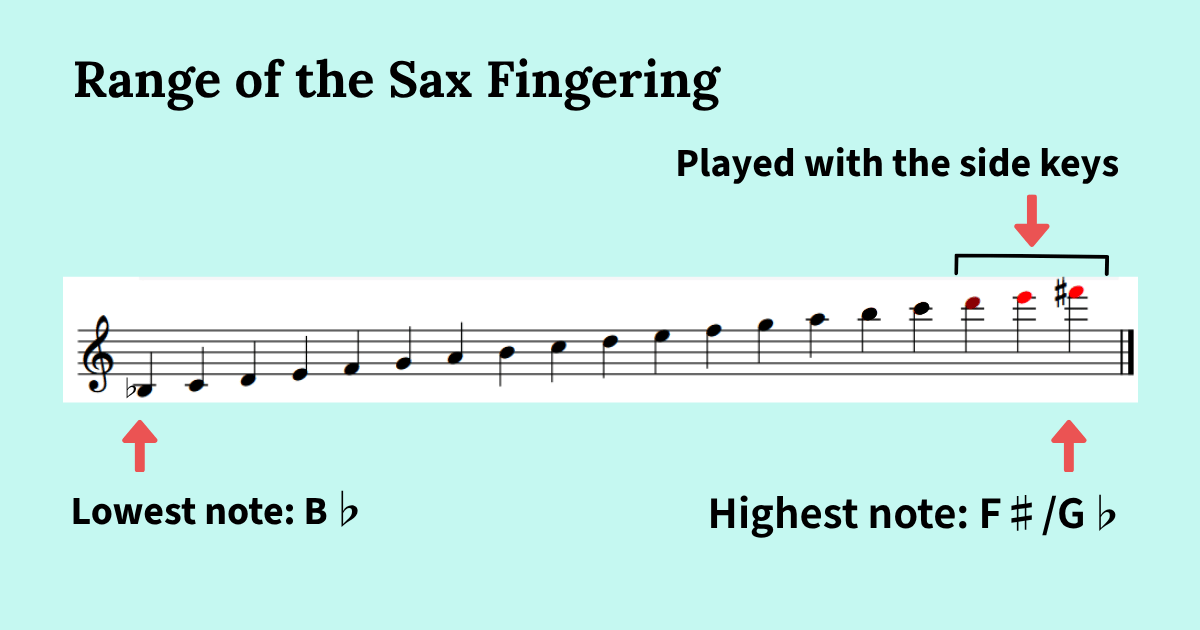
It runs from B♭ up to F♯/G♭, three octaves higher.
The diagram leaves them out, but every semitone inside that range can be played as well. The Aerophone also has an octave shift function, so you can move the whole range up or down.
Now look at the lowest note.
The lowest note of the Sax fingering is B♭. The A one semitone below it cannot be played with the standard Sax fingering.
This is the note I will call the low A throughout this article.
That one semitone is where the story begins.
The Range of "Moongazing"
So what does the song need?
The range of "Moongazing" runs from the low A up to a C three octaves higher.
I made a diagram to compare it with the Aerophone's range.
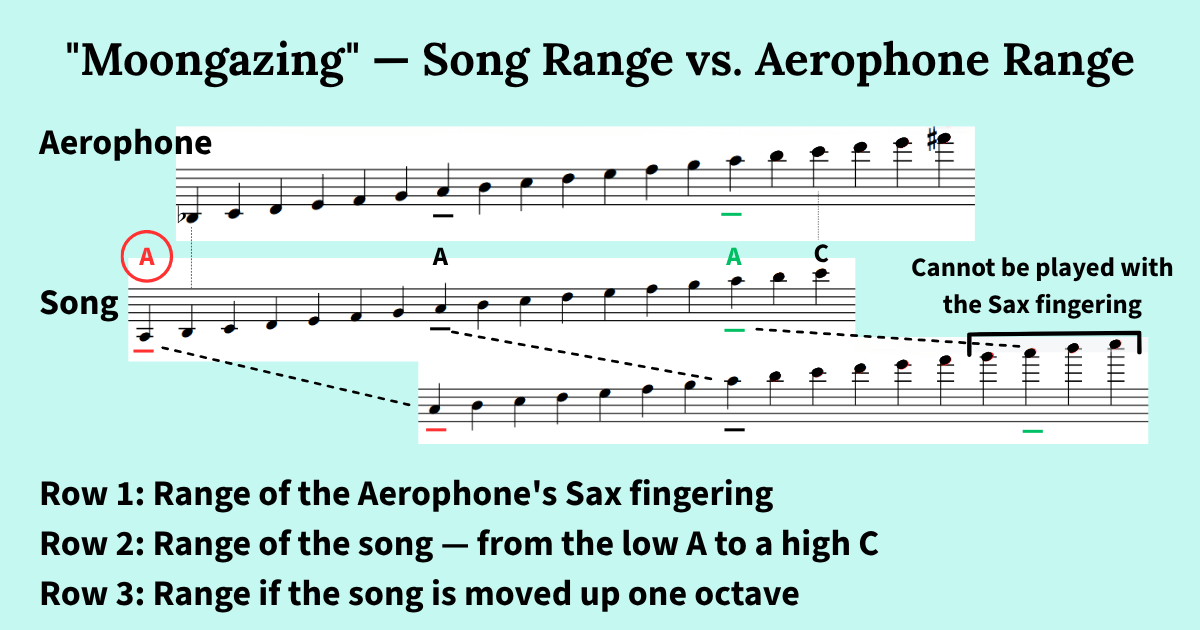
There are three rows. Let's look at them one at a time.
- Row 1: the range you can play with the Aerophone's Sax fingering. Use it as a ruler.
- Row 2: the range of "Moongazing" in its original key.
- Row 3: the range of the song when it is moved up one octave.
- Dotted lines: connect notes of the same pitch.
Look at row 2 first. I marked the song's lowest note, the A, with a red circle.
Follow the dotted line up to row 1, and there is no note at that height. Only the song's lowest note falls outside the Aerophone's range, and only by one semitone.
To put it another way, that is the only note that does not fit. I was one semitone away.
The Aerophone can change octaves freely, so moving the octave should solve it, right?
That was my first thought too. If I start from the A one octave above the low A, the lowest note is no longer a problem. I will call that note the middle A.
Row 3 shows what happens.
The low end fits now. But this time four notes at the top fall outside the range. That is the part marked "Cannot be played with the Sax fingering" in the diagram.
If I match the low end, the lowest note is a semitone short. If I match the high end, the top notes cannot be played. That is how wide the range of "Moongazing" is.
Just one more semitone… I really wish I could play that low A.
That is where the trial and error began.
Method 1: Change the Octave Key Setting
The first method widens the range itself by changing the Octave Key setting.
The octave keys can be set to four options.
- Sax 1: the sax compatible mode. The upper octave key raises the pitch by one octave only.
- Sax 2: the baritone sax compatible mode. The upper octave key raises the pitch by one octave, and the lower octave key extends the lowest note down to the low A.
- Oct2: switches up and down by two octaves with the standard fingering.
- Oct3: switches up and down by three octaves with the standard fingering.
Here is how to change the setting. The steps are the same for every option.
- Press the [MENU] button
- Press the [+] button 52 times to reach the "Octave Key" screen
- Choose a setting and confirm it
52 presses sounds like a lot, but the screen appears within a few seconds if you hold the button down.
Sax 2: the baritone sax compatible mode
This is the setting I chose in the end.
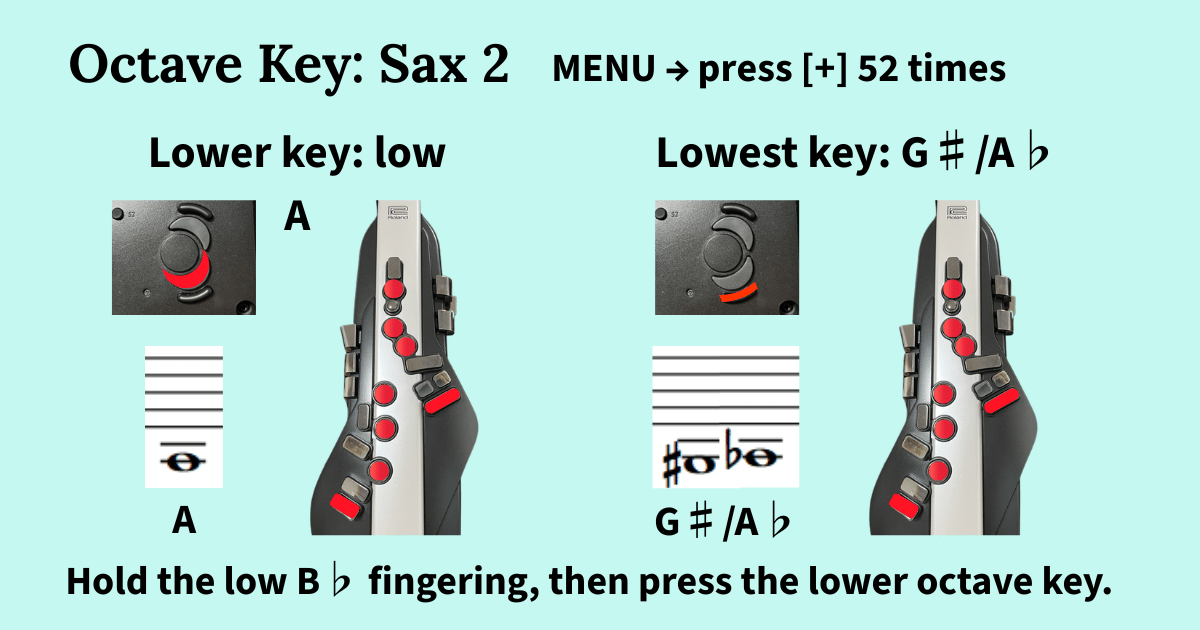
When the Octave Key is set to Sax 2, you can play the low A, and also the G♯/A♭ one semitone below it.
All I can say is that the Aerophone is amazing.
You play it with your left thumb.
Hold the fingering for B♭, the lowest note of the Sax fingering, and press the octave key on the lower side of the thumb rest. The pitch drops a semitone and becomes the low A.
There is one more key below that one. It takes the pitch down to G♯/A♭.
I usually use the upper octave key, so the lower keys took some practice. How easy they are may also depend on the size of your hand and the way you hold the instrument.
In my case the low A appears only three times, always in a "B – A – B" movement, so I moved my thumb each time.
What about the high end? That turned out to be fine.
The highest note in "Moongazing" is a C three octaves up, and the Sax fingering reaches F♯/G♭. So if I start from the low A, I can reach the highest note without changing anything.
Oct2: cover the high notes with the octave key
This method does not play the low A. Instead, it removes the need for it.
When the Octave Key is set to Oct2, you can go up two octaves. Starting from the middle A, you can cover the high notes with the octave key.
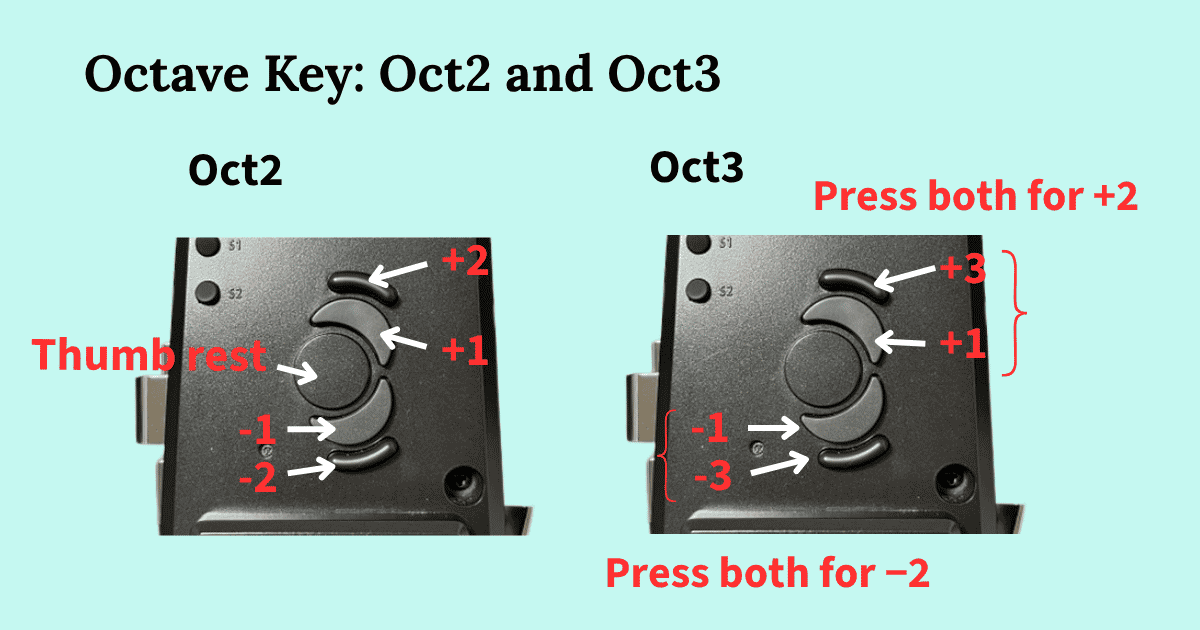
These are the high notes that fell outside the range in row 3 of the earlier diagram. You play them with the octave key instead of the side keys.
However, if you are used to playing the high D, E, and F with the side keys in your usual Sax fingering, you may need to practice the new fingering.
Roland Aerophone AE-20
See full specs and details on the official page:
Roland Aerophone AE-20 — Official Product Page
Method 2: Bend with the Thumb Lever
If you find the lower octave keys hard to press, there is another way.
You bend the note with the thumb lever, using your right thumb.
On the Aerophone you can set the bend width in semitones, from 0 to 24.
In "Moongazing" the low A appears only three times. Each time the movement is "B – A – B," and the A in the middle is the low A.
So I set the Bend Range to 2, which is a whole tone.
Hold the fingering for B, push the thumb lever down, and return it to its resting position. This "bend up" lets you play "B – A – B".
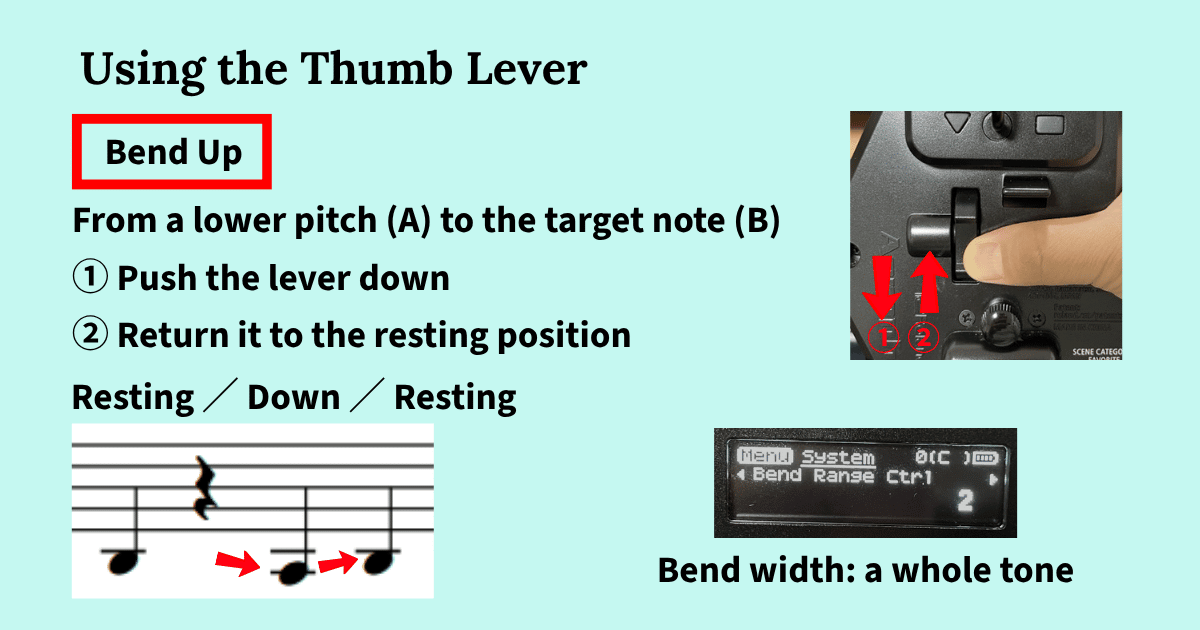
This method is a bend, though, so it may not be as useful in other situations.
Method 3: Change the Fingering Mode to E-Wind
Changing the fingering mode itself is another option.
As I wrote earlier, the Aerophone offers several fingerings. The E-Wind mode, for electronic wind instruments, can play the low A that the Sax fingering cannot.
You change the fingering mode from the [MENU] button, in the same way as the Octave Key setting.
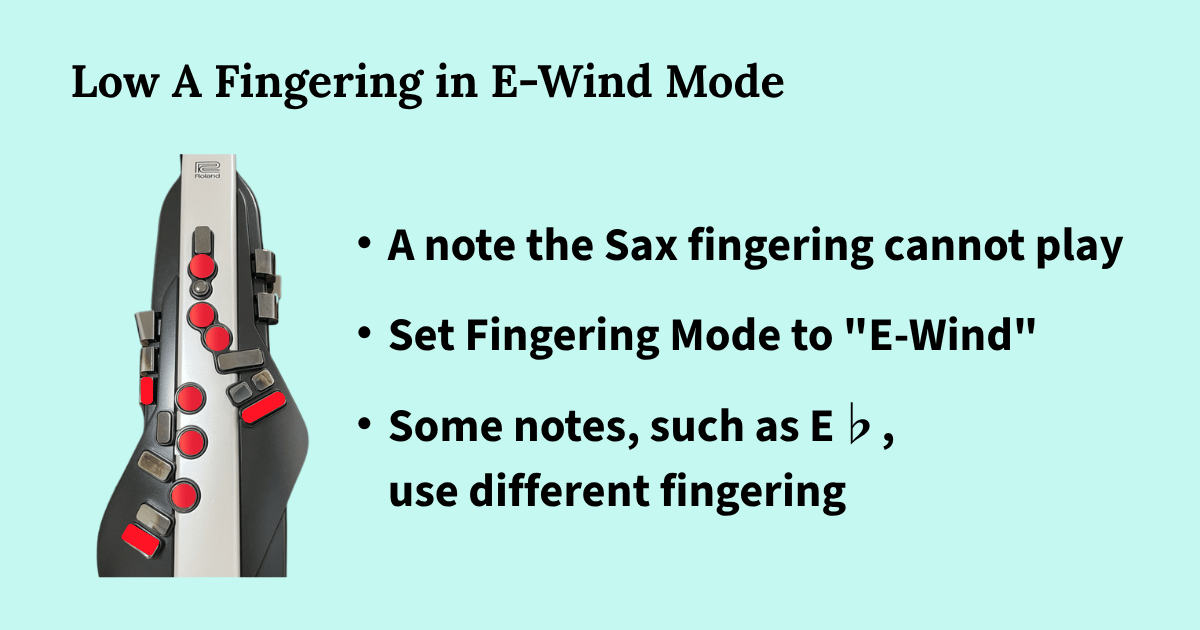
E-Wind is close to the Sax fingering, but a few notes are different — E♭, for example — so it is worth checking before you play.
If the low A appears often in the songs you play, E-Wind is a good option.
Method 4: Transpose the Sheet Music
The last method changes the key of the song itself.
If you transpose, you no longer need the low A. I wanted to keep the original key this time, so I left this as a last resort.
The original key is E minor, with one sharp. I made a table of the keys above it that fit inside the range of the Sax fingering.
| Shift up | New key (minor) | Relative major | Sharps / flats |
|---|---|---|---|
| 1 semitone | F minor | A♭ major | 4 flats |
| 2 semitones (whole tone) | F♯ minor | A major | 3 sharps |
| 3 semitones (minor 3rd) | G minor | B♭ major | 2 flats |
| 4 semitones (major 3rd) | G♯ minor | B major | 5 sharps |
| 5 semitones (perfect 4th) | A minor | C major | none |
| 6 semitones (tritone) | B♭ minor | D♭ major | 5 flats |
This method needs sheet music in the new key.
The mood of the song may change, but G minor and A minor have few sharps or flats, so they look easier to play.
Summary
I looked for ways to play "Moongazing," a song with a wide range, on the Aerophone in its original key.
Here are the four methods again.
| Method | What you do | Advantage | Things to note |
|---|---|---|---|
| 1. Octave Key setting | Set it to Sax 2 to play the low A, or to Oct2 to cover the high notes | The range itself becomes wider, so it helps with other songs | Sax 2 depends on the size of your hand; Oct2 depends on how used to the side keys you are |
| 2. Thumb lever | Set the Bend Range to 2 (a whole tone) and bend up | Can be set in semitones, from 0 to 24 | It is a bend, so it is harder to apply elsewhere |
| 3. E-Wind | Change the fingering mode to E-Wind | A good option for songs where the low A appears often | Some notes, such as E♭, use different fingering |
| 4. Transpose | Move the song into a key that fits the Sax fingering | G minor and A minor have few sharps or flats | The song is no longer in the original key, and you need new sheet music |
There are two points to remember.
- Play the low A itself
- Cover the high notes with the octave key (Oct2)
I played it with the baritone sax compatible mode. This time I wanted to stay with the original key and the original range, and I went as far as I could to do that.
I hope this helps you with a song of your own.