Aerophone Left Thumb: Why Octave Key Timing Is Hard and Where to Place It
🌐 Read this article in Japanese(この記事を日本語で読む)

Hi, I'm Shuko.
The timing of pressing and releasing the octave key is so difficult. My notes keep sounding wrong…
As you play the Aerophone, the octave key under your left thumb starts to cause trouble.
When the timing is slightly off, the note jumps to the wrong octave, or a different note sounds for a moment.
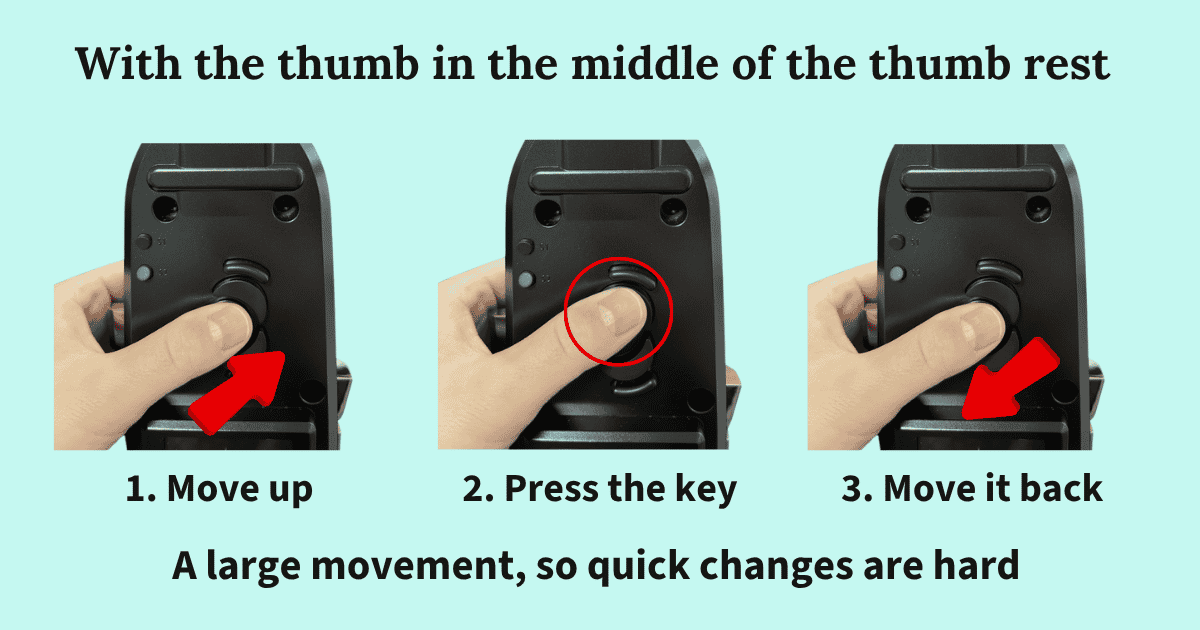
The Owner's Manual tells you to keep your left thumb near the thumb rest. That is correct. The difficulty comes later: once your other fingers begin to move quickly, a thumb that sits in the middle of the thumb rest cannot follow.
In this article, I will share a position that makes playing much easier — keeping your left thumb in contact with both the thumb rest and the octave key.
This article covers the four octave key settings, the thumb position itself, and what to do when your thumb starts to hurt. Feel free to jump to any section from the table of contents below.
* This page may contain affiliate links.
Contents
Octave Key Settings
Like an acoustic saxophone, the Aerophone has octave keys. Let's start by looking at what you can change.
The four settings you can choose
The octave keys have four settings. You can change them to match your taste and your playing style.
- Oct2 (default): two octaves up, two octaves down
- Oct3: three octaves up, three octaves down
- Sax1: sax-compatible mode. The upper octave key raises the pitch by one octave only
- Sax2: baritone sax-compatible mode
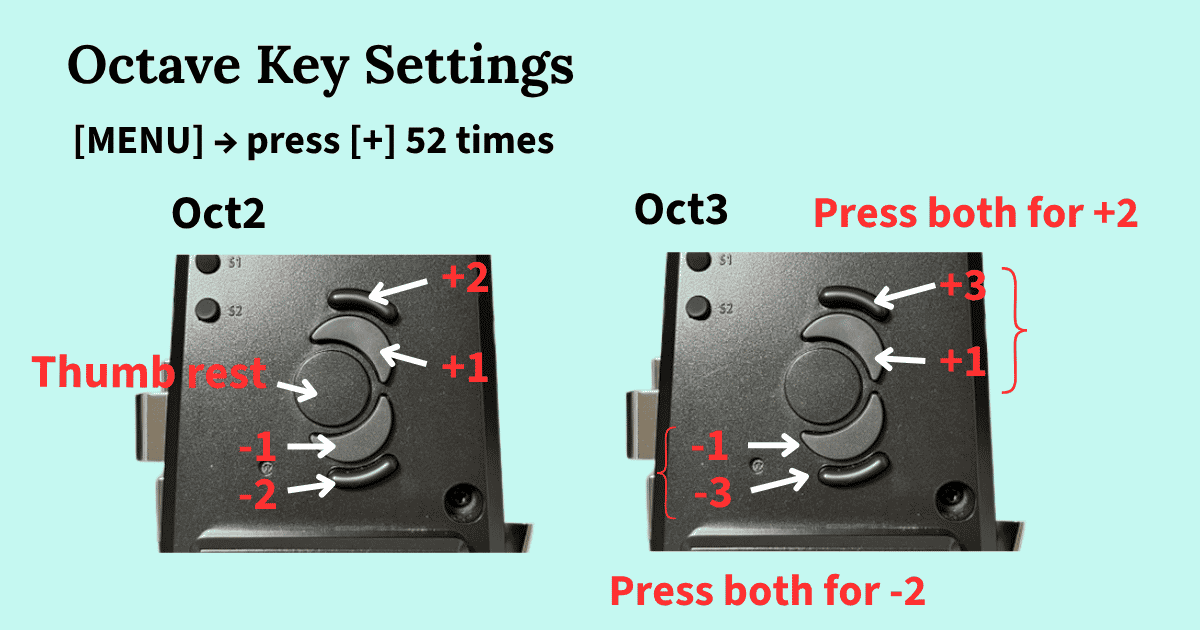
The setting I use
I use Oct2, the default. For now, one octave up covers everything I play.

When I practice with saxophone method books, I almost never need to go one or two octaves down.
The Aerophone has a wide range, so I would like to try many kinds of music with it.
Where Your Left Thumb Should Be
To move the octave keys smoothly, what matters is where your left thumb sits.
The middle of the thumb rest is not enough
The Owner's Manual tells you to keep your left thumb near the thumb rest, and it shows a photo of that position.
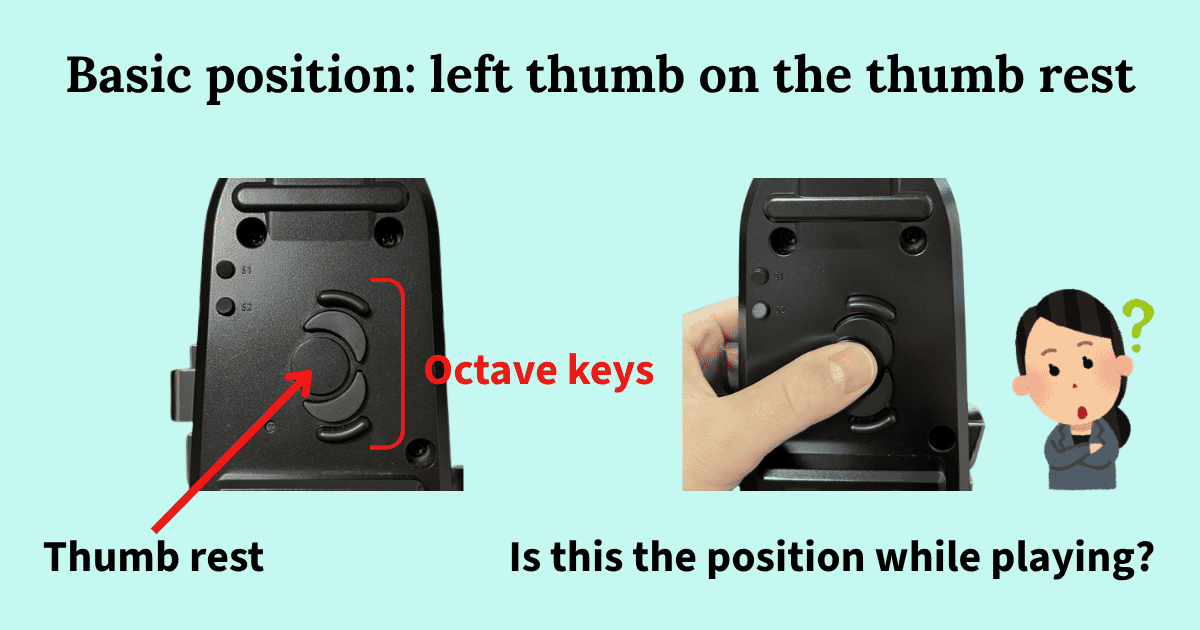
But when you set your thumb in the middle of the thumb rest, you have to move the whole thumb to press the octave key, and again to release it.
If you return your thumb to the middle every time, quick changes are not possible.
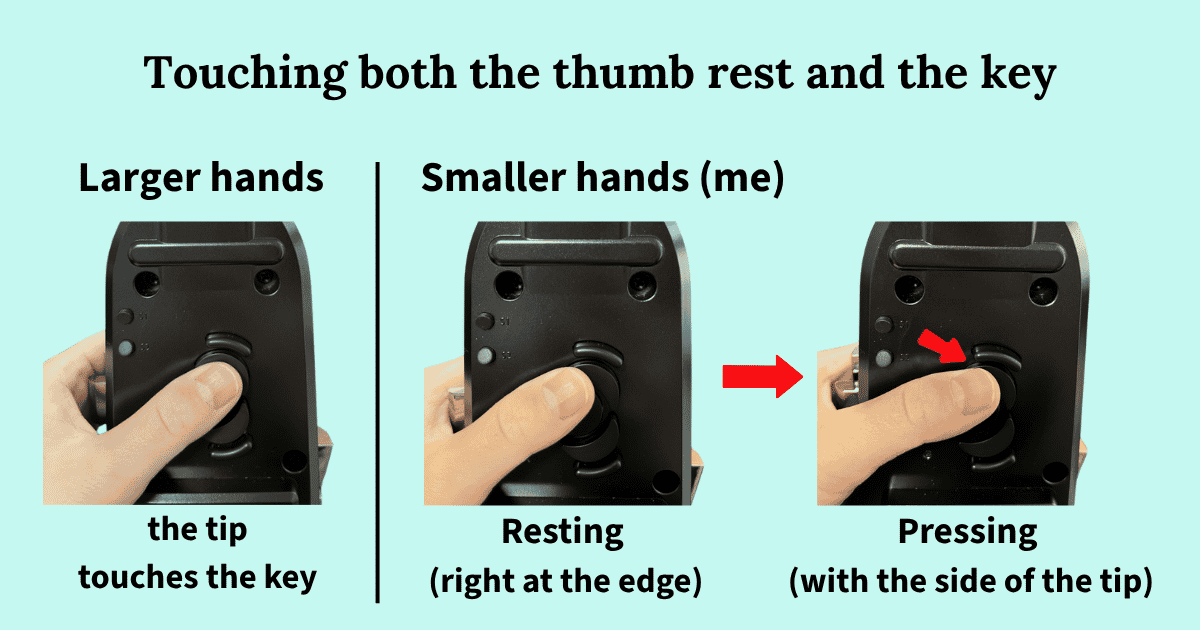
Touching both the thumb rest and the key
If you do not press and release the octave key at the right moment, the note jumps to the wrong octave, a note that is too low or too high sounds, or a different note appears for a moment.
There is a simple change that helps: keep your left thumb in contact with both the thumb rest and the octave key.
When your thumb is always touching the key, you can press it by moving only the top joint of your thumb, the one nearest the tip.
If you have larger hands, your position may look like the photo on the left.
My hands are small, and my thumb touches the side keys. So I place it right at the edge of the octave key, and I press with the side of my thumb, between the pad and the nail.
Roland Aerophone AE-20
See full specs and details on the official page:
Roland Aerophone AE-20 — Official Product Page
When Your Left Thumb Starts to Hurt
Hand size and finger strength are different for everyone. Even when you are careful, it is easy to practice too much.
What practicing too much taught me
I practiced too much and hurt the base of my left thumb.
Notes that cross the octave key — for example, middle C and the E above it, which needs the octave key — did not sound clean. That frustrated me, and I became stubborn about it.
I repeated C–E–C–E and B–D–B–D again and again, and the base of my thumb began to hurt.
Here is what I learned from that.
- Stop as soon as you feel pain
- Take breaks while you practice
- Stretch before you practice
- Something you cannot play today may work a few days later. Do not force it.
A finger cap to reduce the force
Even so, when you are absorbed in it, you practice for hours!
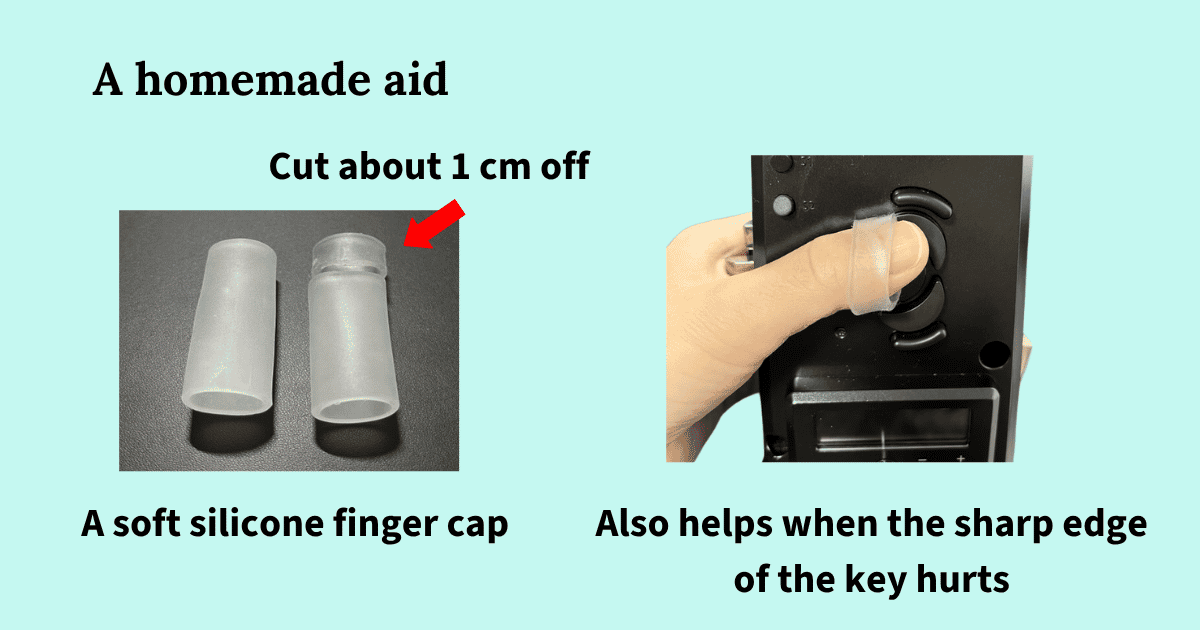
Once you hurt your thumb, the pain returns easily. When I want to save the strength in my thumb, I practice with a silicone finger cap on it.
It softens the force from the sharp edge of the octave key, so I can press the key with less strength.
The caps are sold as fingertip protectors. I cut about 1 cm off the closed end so that the cap fits my thumb.
Summary
Simply keeping your left thumb in contact with both the thumb rest and the octave key makes playing much easier.
Until I asked my teacher, I practiced with my thumb in the middle of the thumb rest, as the manual shows.
Once you know it, it may seem obvious. But it is surprisingly hard for a beginner to notice.
I hope this helps you. And please, practice in moderation.