Aerophone Right Thumb Pain: Why It Hurts and How to Hold It Comfortably
🌐 Read this article in Japanese(この記事を日本語で読む)
Hi, I'm Shuko.
My right thumb starts hurting as soon as I practice the Aerophone.
It hurts so much that I cannot keep practicing, and I lose the motivation to start.
Does this sound familiar? You started because it was fun, and then your hand began to hurt. That takes the joy out of practice very quickly.
The cause is almost always the same: without noticing it, you are supporting the whole weight of the instrument with one finger. The finger in question is the right thumb — the one that touches the thumb hook on the back of the instrument.
This article explains where the weight should actually go, and one surprisingly simple change to your grip that takes most of the load off your thumb.
Let's get you back to practicing comfortably.
* This page may contain affiliate links.
Contents
Why Your Right Thumb Hurts
The Aerophone has a thumb hook on the back of the instrument, and your right thumb touches it while you play.
If your thumb starts hurting soon after you begin practicing, you are very likely supporting the weight of the instrument with the thumb on that hook.
Isn't the thumb hook there to hold the weight of the instrument?
That is what most people assume, and that assumption is exactly what causes the pain.
The weight of the instrument should go entirely to the neck strap attached to the strap ring, so that your shoulders and neck carry it.
Your left thumb touches the thumb rest and your right thumb touches the thumb hook, but neither of them is there to carry weight. They keep the instrument balanced and your posture stable.
I'm not sure I follow.
Let me show you with photos.
What happens when your thumb sits on the hook
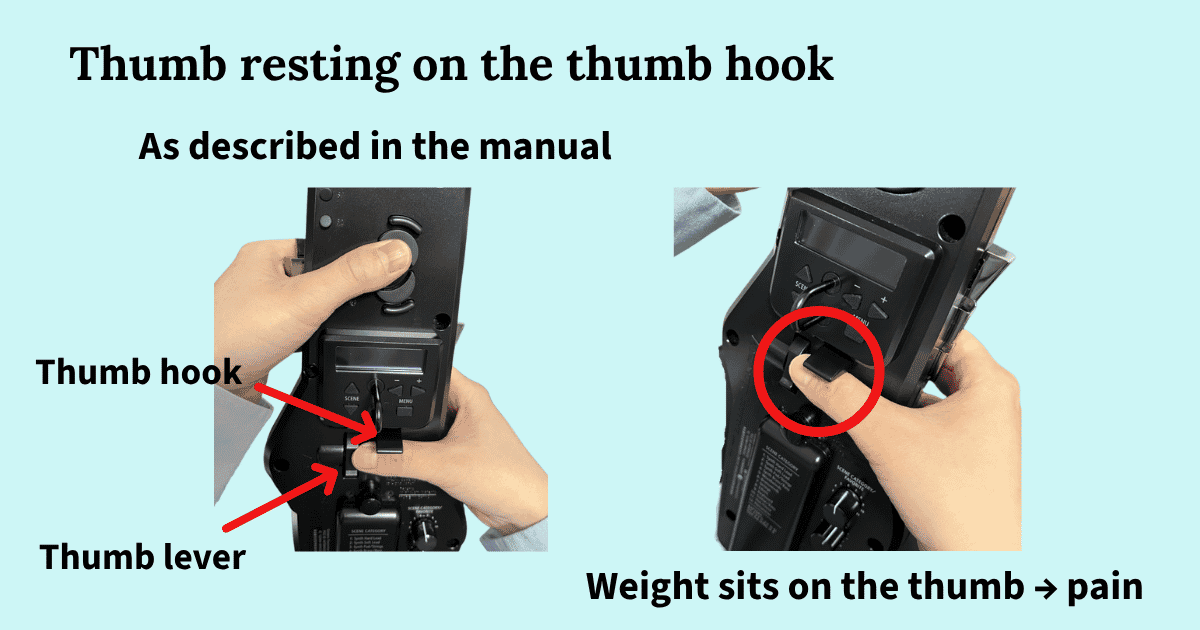
The owner's manual says to rest your right thumb on the thumb hook, and that description is correct. The problem is that "rest on" is easy to read as "support with." If you follow the description too literally, you will hold the instrument like the photo above.
While you are still getting used to the instrument, this position makes you push upward almost automatically. The result is that the instrument sits on top of your right thumb.
The Aerophone comes with a cover for the thumb hook, but a cover does not help much when the full weight is still on your thumb.
The real job of the right thumb is to keep the instrument balanced. So instead of pushing upward, what you want is a light push forward.
In practice, though, that fine control is difficult while your thumb is on the hook. The instrument still comes to rest on top of the thumb.
After reading a lot and trying many things, I found a method that works. Here it is.
Roland Aerophone AE-20
See full specs and details on the official page:
Roland Aerophone AE-20 — Official Product Page
The Fix
Here is the approach that worked best for me. It removes the cause of the pain, not just the pain itself.
Hold your thumb away from the hook
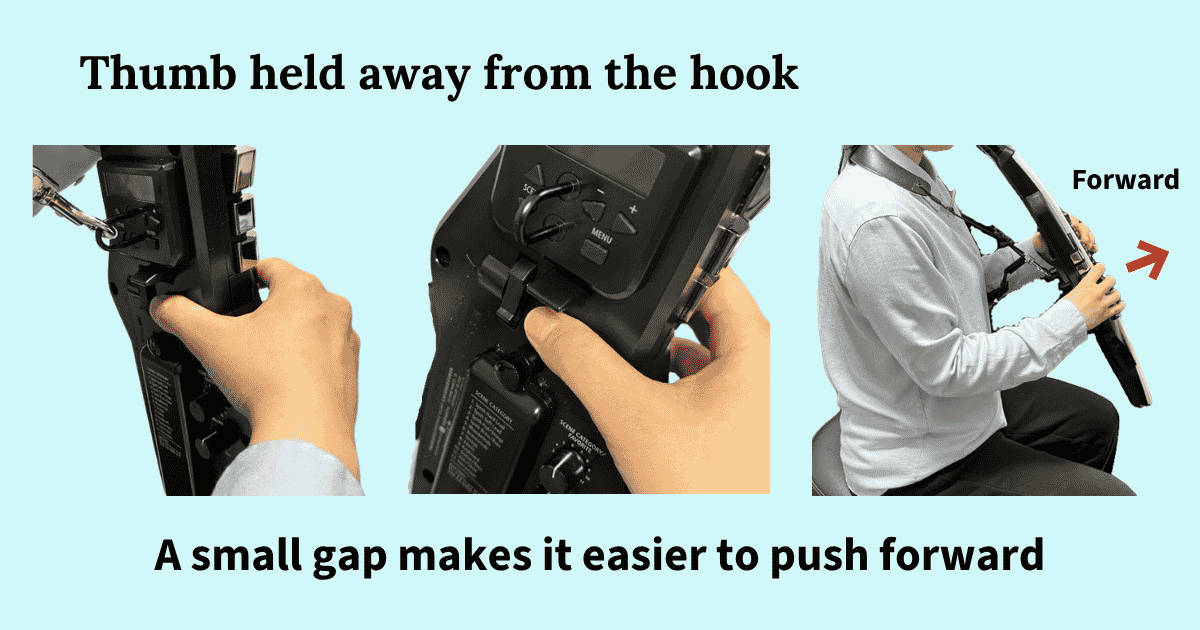
You may be surprised: is it really all right to hold it like that? If your thumb hurts, please try it once.
Holding your right thumb just slightly away from the hook means the weight never sits on it. Adjusting the angle of the instrument and keeping it balanced — the direction of the red arrow in the photo — becomes much easier.
Since I changed to this grip, my right thumb pain has almost completely gone, and playing has become easier.
I still get tired after a long session when I tense up, but I no longer have to stop practicing because of pain.
On an acoustic saxophone, the angle of the thumb hook can be adjusted. On the Aerophone it is fixed and cannot be moved. That is why holding the thumb away from the hook is, for me, the best answer available right now.
- This idea comes from blog posts written by professional saxophone players.
- It is not something a beginner made up, so you can try it with confidence.
How to push forward comfortably
Two small adjustments make the forward push much easier: where your thumb touches the instrument, and the angle of your wrist.
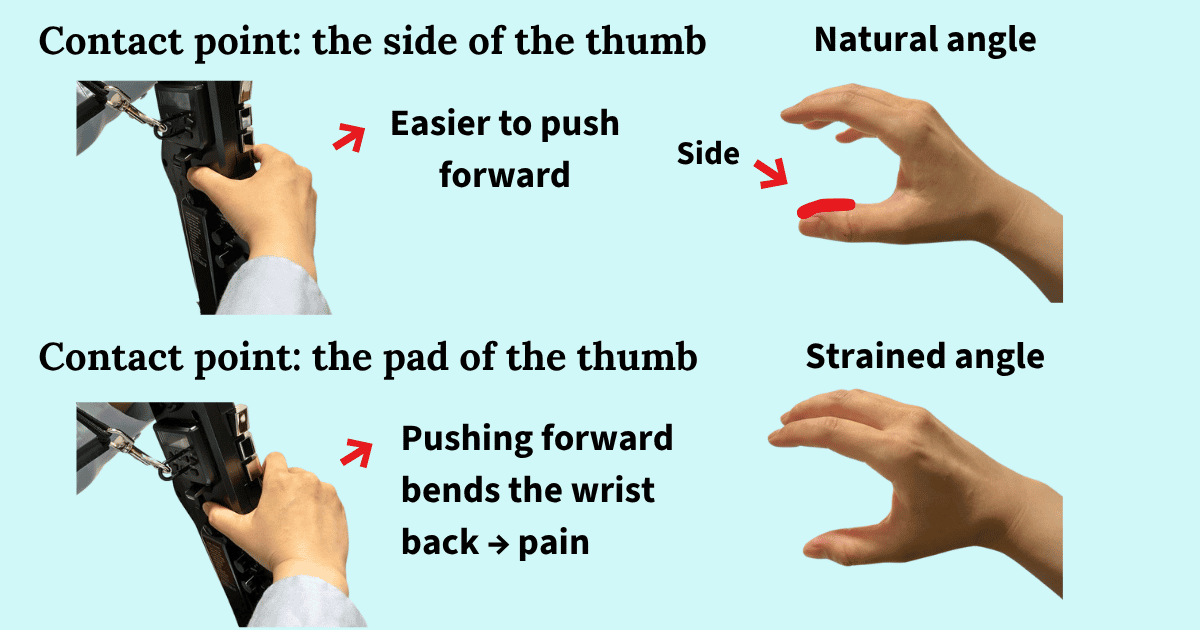
The most important point is to hold the Aerophone as gently as you would hold a plastic bottle or a log.
As the red line in the top right of the photo shows, the side of your thumb should be the part that touches the instrument — the line that runs from beside the nail down to the pad.
If you use the flat pad of your thumb to push forward from directly behind, your palm bends back in an unnatural way, and this can hurt your wrist.
A note on the bend technique
Depending on how far you hold your thumb away, you may no longer be able to reach the thumb lever — the small lever just next to the thumb hook, which bends the pitch up and down.
With my hand size, if I move my thumb any further in, my palm touches the side keys. So I keep it in the position shown in the photo.
When I want to bend a note, I slide my thumb inward for that moment only, operate the lever, and then let it come back.
When I started this blog, I could not bend a note at all. Little by little my thumb got used to the movement, and now I can operate the lever smoothly in slow phrases. It is a small step, but it makes me very happy.
Your playing becomes much more stable when you pay attention to the left thumb as well as the right.
Summary
Right thumb pain is one of the first problems many beginners meet on the Aerophone. This article covered the cause and what you can do about it.
Holding your thumb away from the hook on purpose may sound strange at first, but it removes a great deal of the load from your thumb.
If you feel more stable with your thumb on the hook, then keep it there and focus on the light forward push instead.
- Your right thumb does not carry weight. It only adjusts the angle and the balance, with very light pressure.
- Your left thumb rests lightly on the thumb rest, ready to press the octave key at any moment.
- The full weight of the instrument goes to the neck strap, carried by your neck and shoulders.
When something in your body hurts while you play, it is a sign that unnecessary force is going somewhere.
In sports and in music alike, tension keeps you from playing at your best.
Let's aim for a relaxed, natural way of playing that feels good.