Aerophone Embouchure, Part 2: How I Fixed a Bunched Chin and Air Leaks
🌐 Read this article in Japanese(この記事を日本語で読む)
Hi, I'm Shuko — a music blogger from Japan.

I'm still working on my embouchure, a little at a time.
When you practice the Aerophone, your chin bunches up, or air escapes around the mouthpiece. With the embouchure, there is always one more thing to fix.
The muscles around your mouth are not ones you normally think about. Knowing the correct shape is not the same as being able to make it.
This article is Part 2. In Part 1, I wrote about starting the Aerophone with no wind instrument experience and how my embouchure changed over my first two years. Here I want to show what I actually did during two of those stages: getting rid of the bunched chin, and losing less air.
These are the dates again: I started in June 2022, and this article covers up to August 2024. At the end I have added where things stand now.
I am a beginner, so some of what I concluded may turn out to be wrong. But if you are having the same trouble, I hope it helps to see what one person tried.
Feel free to jump to any section from the table of contents below.
* This page may contain affiliate links.
Contents
A quick recap of Part 1
Let me start with a short summary of the previous article.
Part 1 followed how my embouchure changed from June 2022 onward, stage by stage.
- Biting my lower lip: months 0–8
- A bunched chin: months 8–12
- Fixing the chin: months 12–18, and reducing air leaks: months 12 onward
- Rolling my lip back in: months 24 onward
This article covers what I actually did during the two stages in the middle: getting rid of the bunched chin, and losing less air.
The embouchure I am aiming for
Before the methods, here is the shape I have been working toward.
This repeats what I wrote in Part 1. It is what one beginner arrived at after a lot of trial and error, not a teaching method.
- Most players roll the lower lip inward so that it covers the lower teeth. The reed then rests on the lip, not on the teeth
- How far to roll it in is not fixed. Roll it all the way in and you lose the soft cushion, and the sound gets thin. Most players look for something in between
- Try not to let your chin bunch up
- Shape your mouth somewhere between an "ee" and an "oo", and wrap your lips around the mouthpiece from all four sides — above, below, and both corners
Why the chin bunches up
Before the fixes, it helps to know what is actually happening.
When you take the mouthpiece into your mouth, your lips close around it from every direction — above, below, and both corners. Think of a rubber band tightening around it. That is the job of the ring of muscle around your mouth, the orbicularis oris.
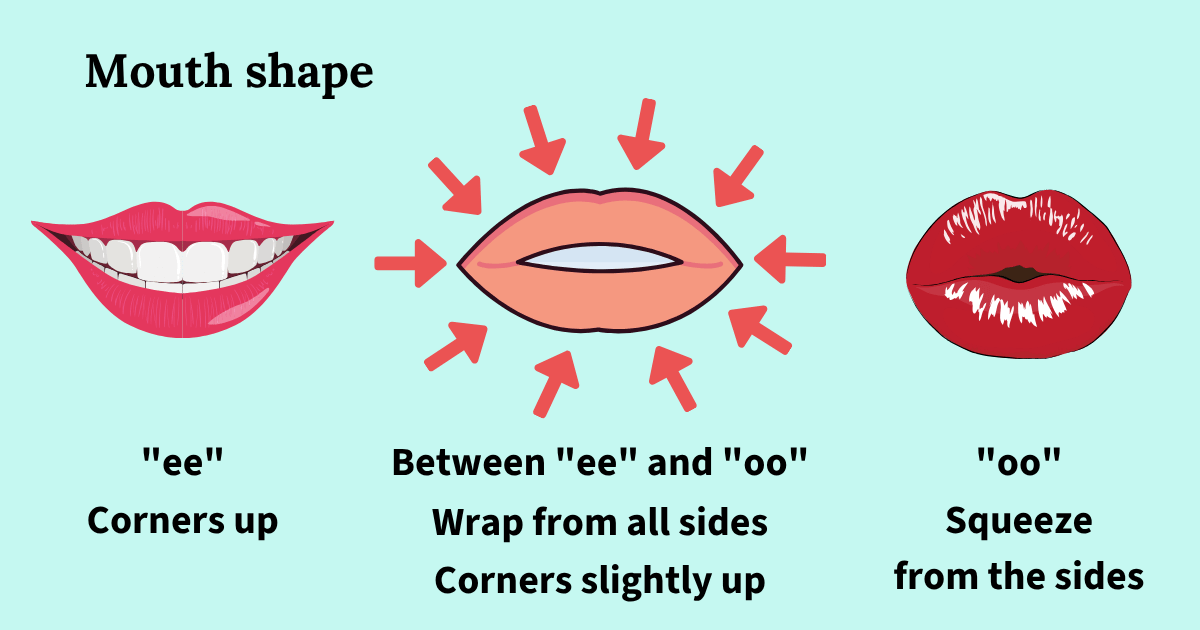
But when the force from above and below gets too strong, the chin bunches up. You can feel this without the instrument. Say "ee" or "oo" and your chin stays flat. Now close your lips and press, as if saying "mm" — your chin bunches.
What is doing that is the mentalis, a muscle that lifts the lower lip and closes it. When the mentalis works too hard, the chin bunches up.
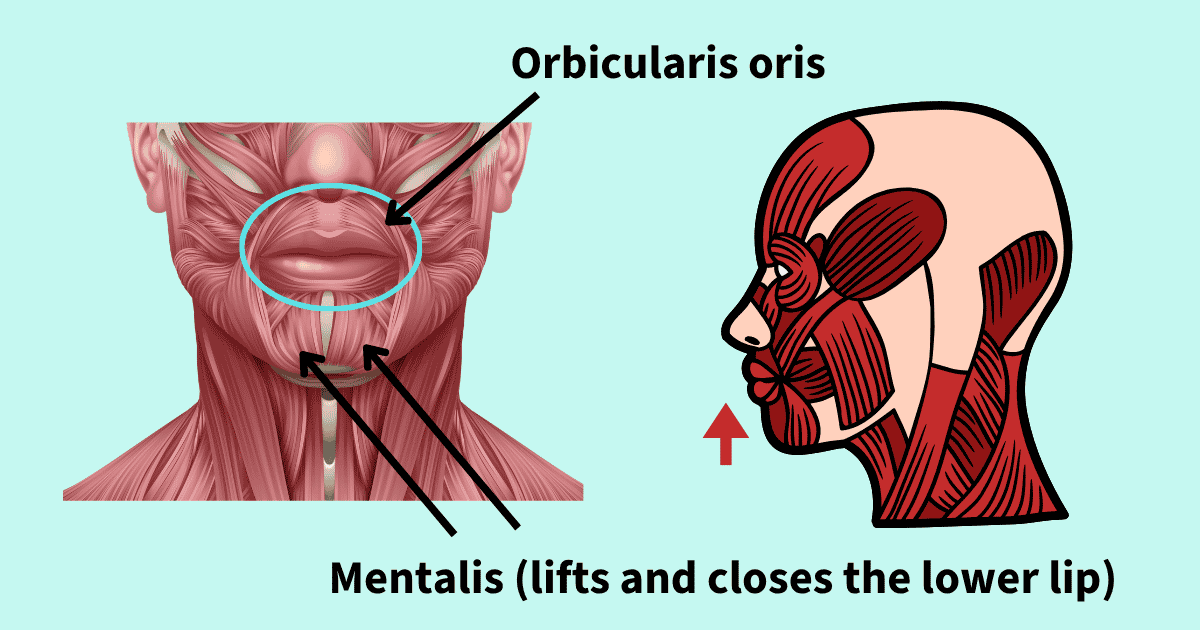
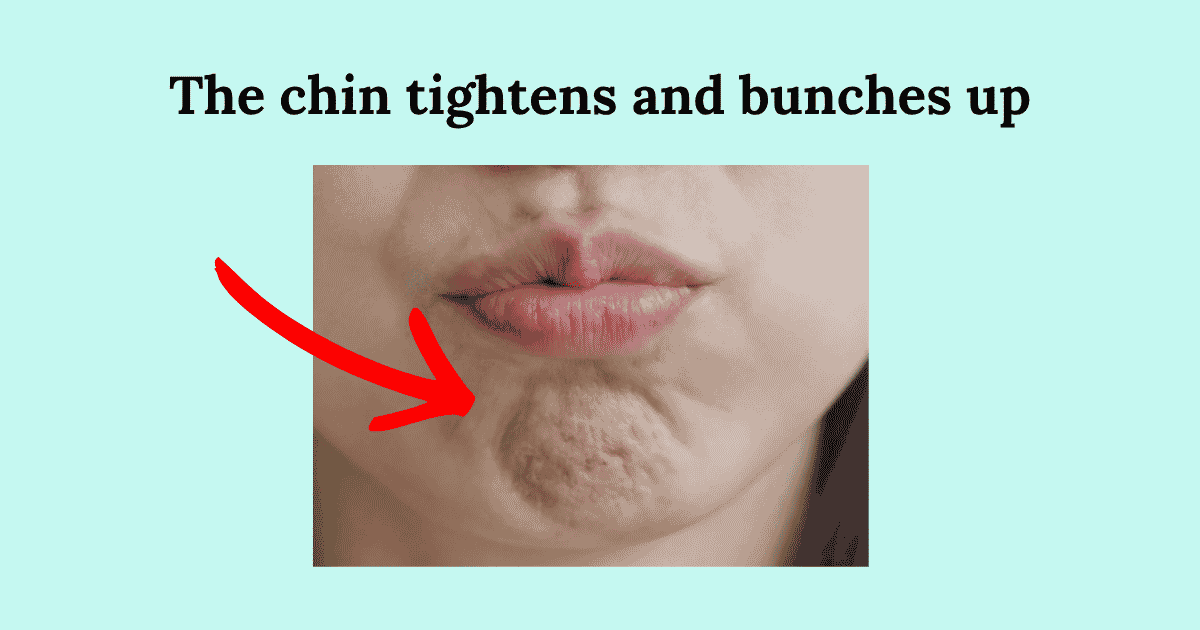
So why does the mentalis work too hard? Because the muscles that squeeze from the corners are weak. We move our lips up and down all day long. We almost never squeeze them inward from the sides.
And you cannot skip it. If your lips do not close around the mouthpiece from every direction, air escapes through the gap.
So the weak corners push you into relying on up-and-down force, the chin bunches, and if it gets worse you start biting your lower lip. That is the loop.
Roland Aerophone AE-20
See full specs and details on the official page:
Roland Aerophone AE-20 — Official Product Page
Fixing the bunched chin: what I practiced
From here on, these are the things I tried in order to build the muscles that squeeze from the corners.
Those muscles had never been used, so they took a long time to grow.
I still could not roll my lower lip in properly, so everything below is what I worked out with the looser, more cushioned shape. Trying one thing after another, the corners slowly came in.
- Practice in front of a mirror
- Set the mouth shape first, then start blowing
- Aim for a light "oo" — do not purse your lips
- Build the shape with "ah" → "eh" → "you"
Practice in front of a mirror
Since the day I decided to fix the bunching, I have never practiced without a mirror. Usually about three times a week, thirty to forty minutes at a time.
I put a small stand next to my music stand at about the same height — a desk works too — and stand a hand mirror on it, so I can check my mouth at any moment.
Set the mouth shape first, then start blowing
Watching the mirror, I take the mouthpiece with no bunching in my chin, and start playing from there. I began with long tones.
If the chin bunched partway through, I stopped and took the mouthpiece again. That was how I kept the mentalis from taking over.
But I also let myself play with a bunched chin for a good part of each session. Without that, practice stops being practice and becomes something to endure. Improving a little at a time was enough.
At first I could only hold it for a few seconds. Slowly, the time without bunching got longer.
It took about six months. By August 2024 I could play most of the time without it. It still comes back when I am tired, so I am still practicing in front of the mirror.
Aim for a light "oo" — do not purse your lips
To train the ring of muscle around the mouth, I also did this without the instrument: "oo" → "ee" → "oo" → "ee", over and over.
Here is the surprising part. Holding a light "oo" tires those muscles far more than a strong one. They start twitching. Those are the muscles you want.
The same is true with the mouthpiece in your mouth. Push the "oo" too hard and your lips purse into a small tight circle, and your teeth lose their place on the mouthpiece.
Rather than squeezing everything as hard as I can, I aim for a moderate, even firmness.
Build the shape with "ah" → "eh" → "you"
This one comes from a video by Mana Arakawa, a Japanese saxophone player. Say "ah" and rest the mouthpiece on your front teeth. Say "eh" and let the tension out of your lower jaw. Say "you" — the same light "oo" as before, not a tight one — and wrap your lips around it.
This was much easier to follow than "somewhere between an ee and an oo", so I practiced it deliberately.
What I liked was the "eh" step. It wraps the mouthpiece from every direction, and at the same time lifts the corners of your mouth a little. Lifting the corners was new to me, and it made sense as soon as I tried it.
For me, though, thinking too hard about lifting the corners loosens the squeeze from the sides, and more air escapes. Getting that balance right is still difficult.
What helped with the air leaks
Next, the adjustments that made a difference during the period when air leaks were bothering me.
Mouth shapes and teeth are different for everyone, so these may not apply to you. But here is what I noticed.
- Do not pull your lower jaw back too far
- Shorten the strap to raise the angle of the instrument
Do not pull your lower jaw back too far
Pulling the lower jaw back does make the chin less likely to bunch. But I was so focused on the bunching that I gradually pulled it back further and further, until it became a habit.
I had also read somewhere that a small hollow under the lip is a good sign, which pushed me the same way.
In the end, pulling the jaw back too far was making the air leaks worse. Easing off that a little, less air escaped.
Habits like this affect more than the air. They also tire out your arms and shoulders. If that sounds familiar, it is worth looking at how you hold the instrument overall.
Shorten the strap to raise the angle of the instrument
Holding the Aerophone at too low an angle turned out to be a cause of air leaks.
The image I use is this: imagine the top of your head being pulled upward, look straight ahead, and bring the mouthpiece to your mouth without moving your face.
For me, shortening the strap a little, so that my upper front teeth sit firmly on the mouthpiece, reduced the air leaks. You are not biting with those teeth, so the amount of pressure is hard to judge. The image is that your upper teeth are supporting the weight of the instrument.
If your neck or shoulders are getting tired, the strap itself is worth reviewing.
Summary
The thing that matters most, I am more sure than ever, is the muscle that squeezes the mouthpiece from the corners of your mouth.
Fixing the chin and reducing the air leaks happened at the same time, and it took a long while before I could feel any result. What that taught me was the value of doing a small amount, steadily, over a long period.
- A bunched chin comes from relying too much on up-and-down force. Build the muscles that squeeze from the corners
- Keep a mirror in front of you and check your mouth as you play
- The "ah" → "eh" → "you" movement helps you feel what wrapping from every direction is like
- Pulling your lower jaw back too far can increase air leaks
- Shortening the strap to raise the angle of the instrument can reduce them
Everyone's mouth, muscles and teeth are different, so some of this may not apply to you at all. This is one person's experience, and there may be mistakes in it.
If you are struggling, a lesson or a session with someone who knows the instrument will show you things you cannot see yourself.
Two years on from where this record ends
I still practice in front of the mirror, and when I get absorbed in playing, the chin still bunches.
But I no longer need "ah" → "eh" → "you". The shape comes on its own now. I think the squeeze from the corners has slowly been growing all this time.
Air still escapes, and it probably always will to some degree. What has changed is that my lips do not hurt, so I have stopped worrying about the bunching and the leaks more than they deserve.
Once your embouchure steadies, the Aerophone gets more and more enjoyable.