Aerophone Embouchure, Part 1: My Two Years of Trial and Error
🌐 Read this article in Japanese(この記事を日本語で読む)
Hi, I'm Shuko — a music blogger from Japan.

Holding the mouthpiece the right way — the embouchure — is really hard, isn't it?
I started the Aerophone with no wind instrument experience at all. Of everything I have had to learn, the embouchure has given me the most trouble, and I am still working on it.
If you have never played a wind instrument, the muscles around your mouth have never done this job before. Not being able to do it at first is normal.
This article is a record of how my embouchure changed over time, and what I tried at each stage. Biting my lower lip, a bunched chin, and air leaks — each of these was my main problem for a while, and each one changed how I play.
A note on the dates: I started playing in June 2022, and this article covers my first two years, up to August 2024. That was the period when my embouchure changed the most. Part 2 is about the specific things that worked, if you would rather have the fixes than the story.
I am a beginner, so some of what I concluded may turn out to be wrong. But if you are having the same trouble, I hope it helps to see how another beginner dealt with it.
Feel free to jump to any section from the table of contents below.
Along with the embouchure, the other thing worth checking early on is the instrument's own settings.
* This page may contain affiliate links.
Contents
What an embouchure is
"Embouchure" is a French word. It means the shape of your mouth, and the way you use the muscles around it, when you play a wind instrument.
The Aerophone's mouthpiece is the same type as a saxophone mouthpiece, so much of what saxophone players say about embouchure applies here too. That is why I read so much saxophone material while I was struggling.
I should be clear about where I am starting from. I am not a saxophone player. I have tried an acoustic saxophone once or twice, just to see what it was like. That was all. The Aerophone in 2022 was the first wind instrument I ever owned, and the first one I ever learned. Everything below is what a complete beginner worked out by trying things, not what a trained player already knew.
The points that came up most often
The manual is short, so I went looking for more. I read saxophone books, websites and videos, and the same points kept coming up.
- Most players roll the lower lip inward so that it covers the lower teeth. The reed then rests on the lip, not on the teeth
- How far to roll it in is not fixed. Roll it all the way in and you lose the soft cushion, and the sound gets thin. Most players look for something in between
- Try not to let your chin bunch up
- Shape your mouth somewhere between an "ee" and an "oo", and wrap your lips around the mouthpiece from all four sides — above, below, and both corners
There is far more to it than this, but as a beginner, this was about as much as I could hold in my head at once.
From here on, this article follows what actually happened to me, month by month.
Biting my lower lip: months 0–8
The first stretch was one long fight with my lower lip.
I began by rolling my lower lip in over my lower teeth, the way most sources describe. The trouble was that I kept biting down on it. The pain limited me to about ten minutes of practice at a time, and that went on for months.
When I kept going anyway, the inside of my lip would start to bleed. I nearly gave up during this period.
Later I learned that this is one of the best-known beginner problems on the saxophone as well. New players often assume the lower lip is a cushion for the teeth to press into. It is not. The lower teeth press on the lip and restrict the blood flow, and that is where the pain and the tiredness come from. Knowing this would not have fixed anything, but it would have told me I was not the only one.
So why was I biting? To keep air from escaping, you have to close around the mouthpiece from all four sides — above, below, and both corners. I had never used the muscles that squeeze from the corners, and at that point they were not strong enough to do anything. With no force coming from the sides, the only force I had left was up and down. Up and down means teeth.
When I tried an acoustic saxophone later on, I finally understood why this went on for so long. On a saxophone, biting too hard stops the reed from vibrating, and the sound stops with it — the instrument tells you immediately that something is wrong. The Aerophone's reed is plastic and does not vibrate, so the sound keeps coming however hard you bite. Nothing tells you to stop, and biting felt like the only way to keep the air in.
Bad playing posture was part of it too. The way I was sitting pushed me into biting harder.
Roland Aerophone AE-20
See full specs and details on the official page:
Roland Aerophone AE-20 — Official Product Page
A bunched chin: months 8–12
After months of pain, I finally admitted that something had to be wrong.
Ten minutes of practice is not a sensible limit for anyone. So I stopped trying to roll my lower lip in, and tried the opposite.
When a beginner simply puts the mouthpiece in their mouth without thinking about it, the lip settles into place by itself, with more of the soft cushion left outside the teeth. That is roughly what I switched to. I bit down far less often, my practice sessions got longer, and playing became fun again.
There was a cost, though. I still had almost no force coming from the corners of my mouth, so I was still pressing from above and below, and my chin began to bunch up.
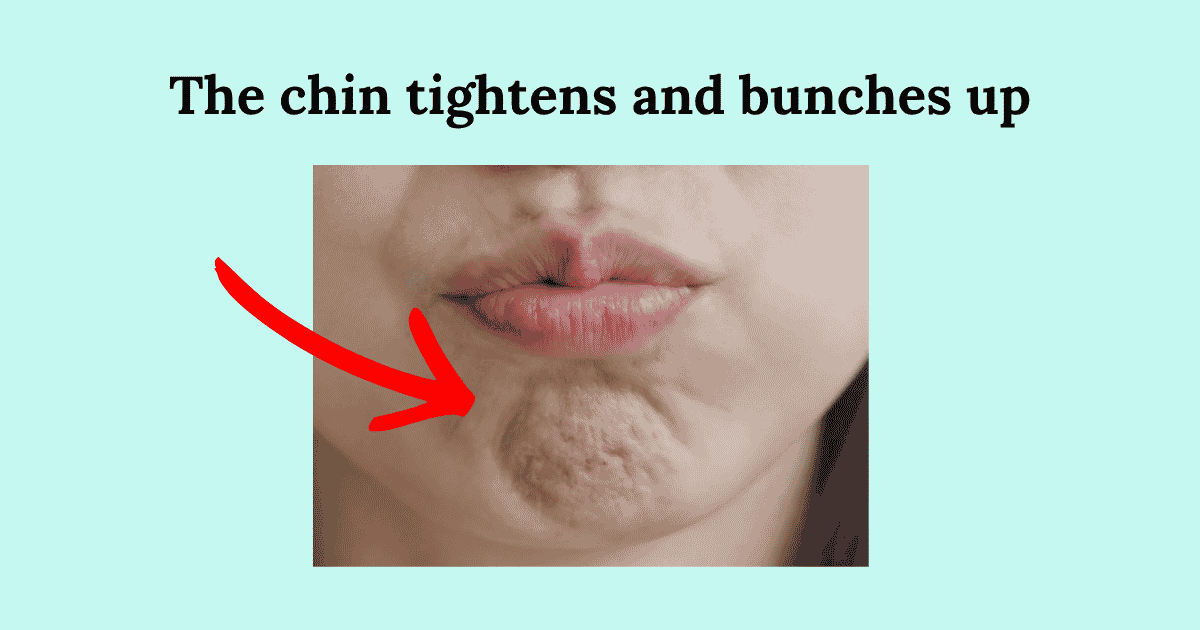
Some people online say a bunched chin is fine as long as the sound is good. I was not sure. When I looked at photos of saxophone players, most of them did not have it, and the teacher I was taking lessons with told me I was putting too much force into my lower jaw. So I decided to fix it.
Fixing the chin, fighting air leaks: months 12–26
This was the period when two fights overlapped: the chin, and a new problem that came with fixing it.
Getting rid of the bunched chin meant giving up the up-and-down pressure I had been relying on. But the force from the corners of my mouth was still weak, so air started escaping around the mouthpiece — much more than before.
That combination went on for a long time.
Not all mouthpieces are the same
The chin problem made me want to rebuild my embouchure properly, so I bought a second mouthpiece to practice with. That is when I found out that two mouthpieces are not necessarily identical.
Compared with the one that came with the instrument (bought in June 2022), the one I bought separately (March 2023) had a slightly narrower tip opening — the gap between the tip of the mouthpiece and the tip of the reed. After I switched to it, less air escaped.
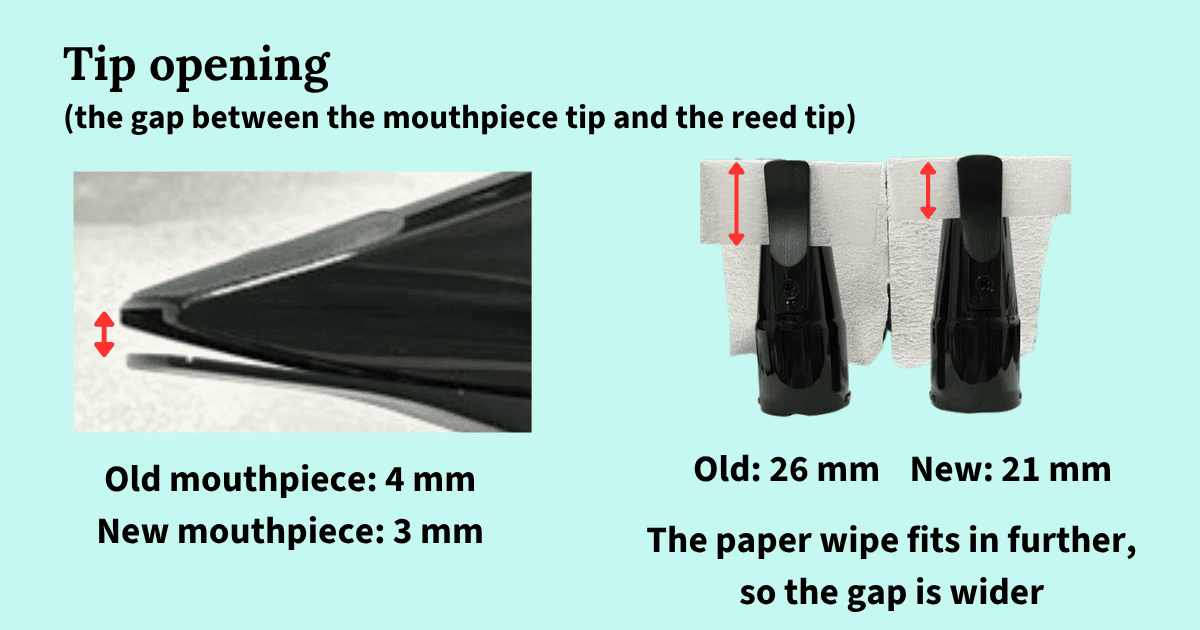
The Aerophone's mouthpiece is shaped like a saxophone mouthpiece, but the reed is plastic, so it is fairly stiff.
If your embouchure is solid, either one is probably fine. As a beginner, I found the narrower opening easier to manage.
How much air I was losing
This is only how it felt to me, not a measurement. But the amount of air escaping changed like this.
| Period | Air escaping (my own estimate) |
|---|---|
| While my chin was bunching | About 1/4 of my breath |
| Fixing the chin — old mouthpiece | About 1/2. A huge loss. I could barely hold a note |
| Fixing the chin — new mouthpiece | About 1/3. Still a lot |
| At 26 months (August 2024) | About 1/5 to 1/6 |
By August 2024, 26 months in, the bunching had almost stopped and much less air was escaping. With the old mouthpiece, a lot still escapes even now.
Even so, when I practice for a long time or when I am not feeling well, I still bite my lower lip, my chin still bunches, and more air escapes. When that happens I take a break, or stop for the day rather than push through it.
Rolling my lip back in: months 24 onward
Near the end of these two years, I came back to the technique I had given up on at month 8.
After I stopped rolling my lower lip in, I spent a long time working on the chin and on the air leaks, and my embouchure settled into the looser, more cushioned shape.
The bunching was mostly gone by then, but I still wanted to lose less air. My teacher suggested I try rolling the lip in again. I had not done it in a long time, and when I tried, there were moments when almost no air escaped at all. That was enough to make me want to work on it properly.
So this is where the two years end: back at the technique I gave up on at the start, but this time my mouth could handle a little of it. If I pushed too hard, my lower lip still started hurting quickly, so I took it slowly, a little at a time.
What I would tell a beginner
Looking back over all of this, here is what I think matters most.
Since those first eight months, I have applied one rule to everything I play: if it hurts, something is wrong. Not just the lips. I have had pain in my shoulders, my neck, my lower back, my wrists and my fingers.
None of it was solved by willpower. Every time, I assumed there was a way to do it without pain, and went looking for it.
The teacher I was taking lessons with mattered enormously here. Without someone to ask, I would almost certainly have quit during those first eight months. I am still grateful to her for catching me one step before I gave up.
There is a lot of information online. But being watched and corrected in person is completely different.
If you are stuck on something right now, ask someone who knows the instrument to watch you play. Even once is enough. They will see something you cannot.
Summary
This has been a record of one beginner working through the embouchure.
From the very first day to the end of these two years, one thing never stopped being difficult: building the muscles that squeeze the mouthpiece from the corners of the mouth. Every problem in this article came back to that.
When I stopped paying attention, I went back to pressing from above and below, and the biting and the bunching came back with it.
- If you keep biting your lower lip, look at your posture and at the direction your force is coming from
- A bunched chin usually means you are relying on up-and-down pressure
- Two mouthpieces are not always identical
- When it hurts, stop and rest. Assume there is a way to do it without pain
- A teacher, even occasionally, makes it much easier to find what to fix
The shape of your mouth, your muscles, how much you practice — there are many factors, and I am sure people improve at different speeds. What I can say is that this takes time.
Two years on from where this record ends
I have hardly touched the rolled-in lip since. There is still air escaping, my chin still bunches sometimes, and there are so many other things to work on — posture, breathing, how I release the air — that I have not had much room left for the embouchure.
One thing has changed completely, though. My lips do not hurt any more. Not at all.
Keep practicing at your own pace, and one day you will notice yourself thinking, "wait — I can do this now." That day does come.
I hope this is useful to someone.