Aerophone Seminar 2026: A Pro Player, the Brisa, and 10 Years On
🌐 Read this article in Japanese(この記事を日本語で読む)
Hi, I'm Shuko.
On August 23, 2026, I went to an Aerophone seminar held by Shimamura Music, a music store chain here in Japan that also runs lessons and events.
The first one was held in the summer of 2025, and I had been looking forward to this year's ever since.
As in 2025, the guest was Masahiko Fujimoto, a saxophone and Aerophone player. He performed, gave a lecture on playing technique, and took part in a talk session. It was an enjoyable hour, and I learned a lot.
Here is a detailed report of the day.
Contents
About the Seminar
The seminar was held at Shimamura Music, with Masahiko Fujimoto, a saxophone and Aerophone player, as the guest.
Last year the program was a performance, a lecture on technique and sounds, and a question session. Everyone in the room was enjoying it too much to watch the clock. It ran well past its scheduled end time.
This year there was more. Mr. Fujimoto also played the Brisa, the flute-style Aerophone released in November 2025. And there was a talk session with Mr. Terada of Roland Corporation, one of the people who developed the Aerophone.
Here is how the day was structured.
- A performance on the Aerophone AE-20 by Mr. Fujimoto
- A lecture on technique and tips for playing better
- A performance on the Brisa by Mr. Fujimoto
- A talk session and question time with Mr. Terada, marking 10 years of the Aerophone
- An ensemble piece for three Aerophones and a Brisa ("Omens of Love")
- Hands-on time with the instruments
The AE-20 Performance
Hearing a professional play the Aerophone live is a rare chance.
Most of those chances come from events like this one: seminars and live shows run by Shimamura Music, or the Roland booth at festivals such as La Folle Journée Tokyo and the Hibiya Music Festival. Both are large music festivals held in Tokyo.
You can hear performances on YouTube, of course. But hearing a professional in the same room is a different experience.
This time he played five pieces, each with a different sound.
- "Jonetsu Tairiku" by Taro Hakase — the theme of a long-running Japanese TV documentary series
- "Truth" by T-SQUARE
- "Takarajima" by T-SQUARE — a standard in Japanese wind bands
- "Going Home" by Kenny G
- The main theme from Detective Conan by Katsuo Ono — the series is known as Case Closed in North America
It reminded me that the Aerophone is not only for saxophone sounds. It also plays synthesizers and string instruments. That range is one of the real attractions of this instrument.
Watching a professional's breathing and fingers from close up, with the sound coming through large speakers, is always striking.
Every single note carried expression, and each piece held together as a whole. There were also fast ornaments, glissandos, and portamentos. The performance was full of advanced technique.
Before the music started, I had a plan. I would watch closely how a professional plays — the posture, the breathing — and look for things I could use myself.
Then the music began. The sound was so beautiful that I closed my eyes and simply listened.
The same AE-20 can sound this different depending on who is playing it. At the same time, I felt how much expression the Aerophone is capable of. I feel both of these things whenever I hear a professional play.
I cannot post video here for copyright reasons. If you have the chance one day, please hear a professional play in person.
The Lecture: Tips for Playing Better
This part of the seminar answered the question many of us came with: how do you actually play the Aerophone well? I will cover two of the topics here.
There was also a topic on how playing technique changes with the sound you choose. I wrote about that in a separate article.
Breath curve (breath sensitivity)
Mr. Fujimoto gave specific advice on how to set the breath curve.
Some of this overlaps with last year's article, but he went into more detail this time, so I am covering it again.
He started with an observation. Saxophone players who pick up the Aerophone tend to set the breath curve heavy. They are trying to make the Aerophone feel like a saxophone.
The Aerophone's breath curve has eleven steps. From lightest to heaviest, they run L5 to L1, then M, then H1 to H5.
Mr. Fujimoto uses L3, a light setting. His reasoning was this.
- Set it too light, and even a small breath produces a loud note. That makes dynamics hard to control.
- Set it too heavy, and playing becomes exhausting.
His recommendation applies to anyone playing the Aerophone. Find the setting where you can produce both your quietest note and your loudest note without strain.
As for breath in general, he said it is better to enjoy the Aerophone as its own instrument, separate from the saxophone.
Using the Aerophone as a practice tool
If breath works differently on the Aerophone, then it is not well suited to practicing saxophone breathing. So how should a saxophone player use it?
His answer: if you are using the Aerophone to practice at home, use it for fingering practice.
Mr. Fujimoto does this himself. He uses the Aerophone to work on fingering before rehearsals, and he said it works well.
The Brisa Performance
The other big draw of this seminar was the Brisa.
Mr. Fujimoto is a saxophone player, so I assumed someone else would play it.
I was wrong. He played it himself. The piece was "Carrying You," the ending theme from the Studio Ghibli film Castle in the Sky, written by Joe Hisaishi. It turns out he plays the flute as well.
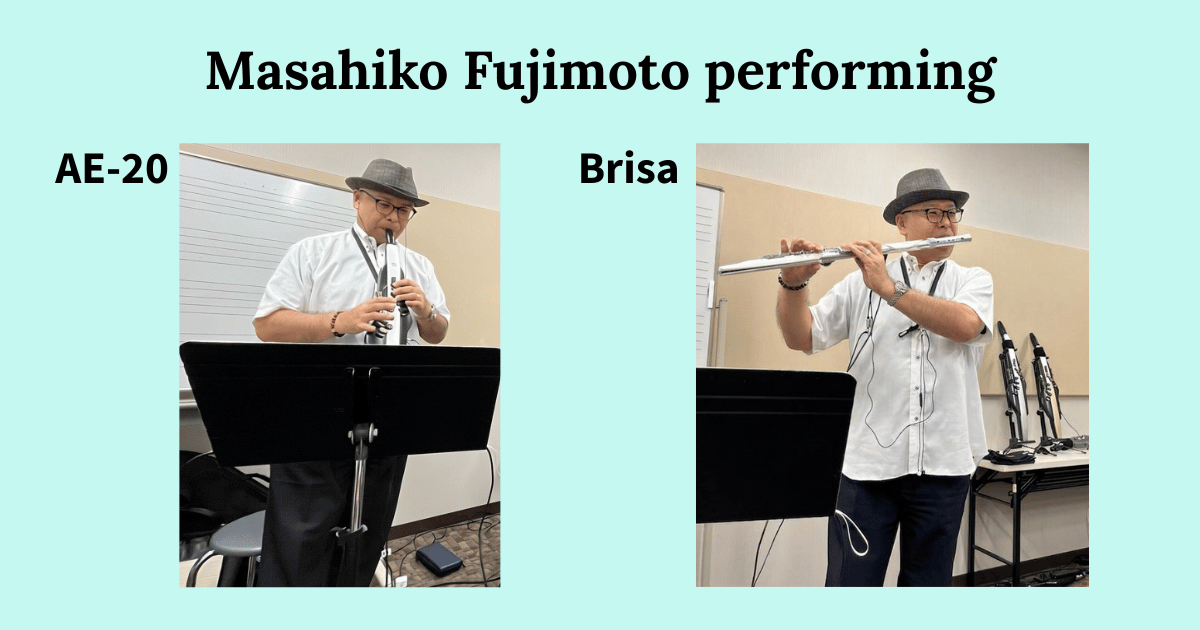
A flute instructor from Shimamura Music then joined him, and together they explained what the Brisa is like and how it differs from a flute.
The first thing to say is that the Brisa sounds wonderful.
What stayed with me was the explanation of the two openings on the mouthpiece. The Brisa has two, and you can either blow into them as though they were one, or use them separately to switch between octaves. Mr. Fujimoto plays them as one. Using them separately may take time to get used to, he said.
They also covered the features, including the Aerophone Brisa Plus app, which lets you change sounds from a phone or tablet. If you want to know more about the Brisa itself, I wrote a hands-on review here.
Talk Session with Mr. Terada, the Aerophone's Developer
A performance and the Brisa would already have been enough for one afternoon. But there was more.
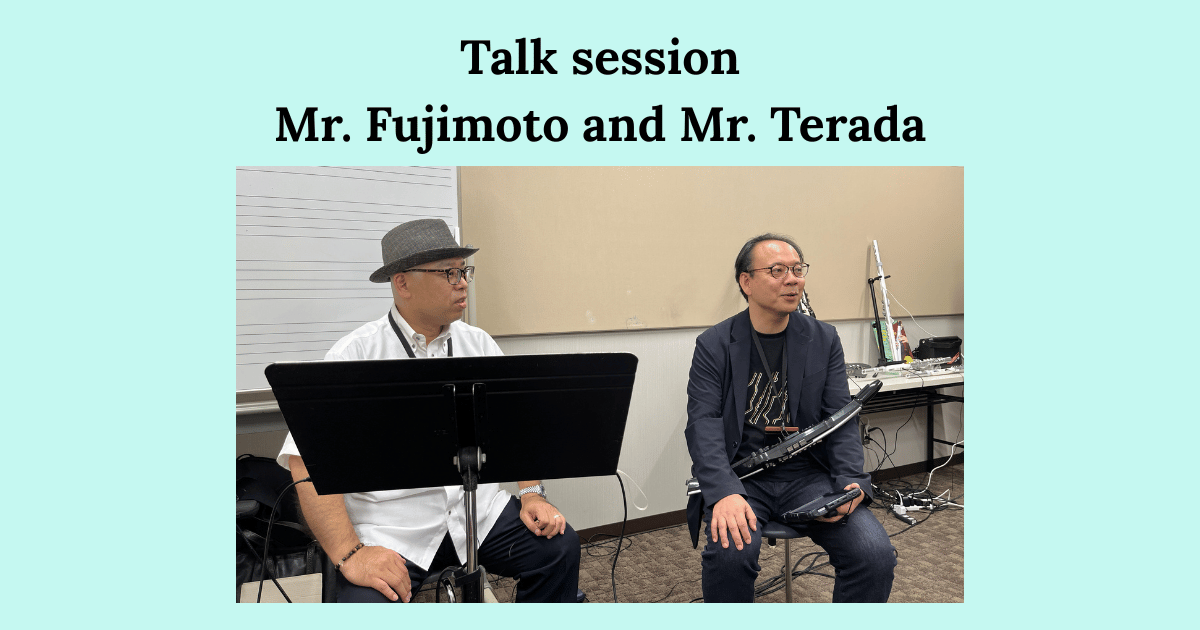
This year marks 10 years since the Aerophone was released. To mark it, Mr. Terada joined Mr. Fujimoto on stage. He talked about how the Aerophone came to be, and about the difficulties along the way. These are not things you usually get to hear.
According to Mr. Fujimoto, wind synthesizers were in a quiet period 10 years ago, when the Aerophone was released.
Then the Aerophone arrived and became far more popular than anyone at Roland had expected. Other companies began putting effort into wind synthesizers again. And then came the Brisa, a flute-style instrument that no one saw coming. That was the shape of the last 10 years.
Mr. Fujimoto has been giving feedback since the early stages of development, as a professional player, with requests and suggestions for improvement.
Mr. Terada is a tuba player himself. He took those professional opinions seriously and worked hard to make the instrument better. Both of them play wind instruments. That was what connected them.
The white used on parts of the Brisa's body comes from the concept color of the AE-10, the first Aerophone, which is no longer in production.
It was a moving story, and it stayed with me.
Questions came from the audience too, and they went deep — the challenges of the engineering work, and the Aerophone's CC (control change) function among them. The room was fully engaged.
An Ensemble of "Omens of Love"
To close, four players performed together: Mr. Fujimoto, Mr. Terada, and the saxophone and flute instructors from Shimamura Music. Three Aerophones and one Brisa.
The piece was "Omens of Love" by T-SQUARE. Saxophone, tuba, trumpet, and synthesizer — four different sounds, all from digital wind instruments. It was a treat.
Display and Hands-On Time
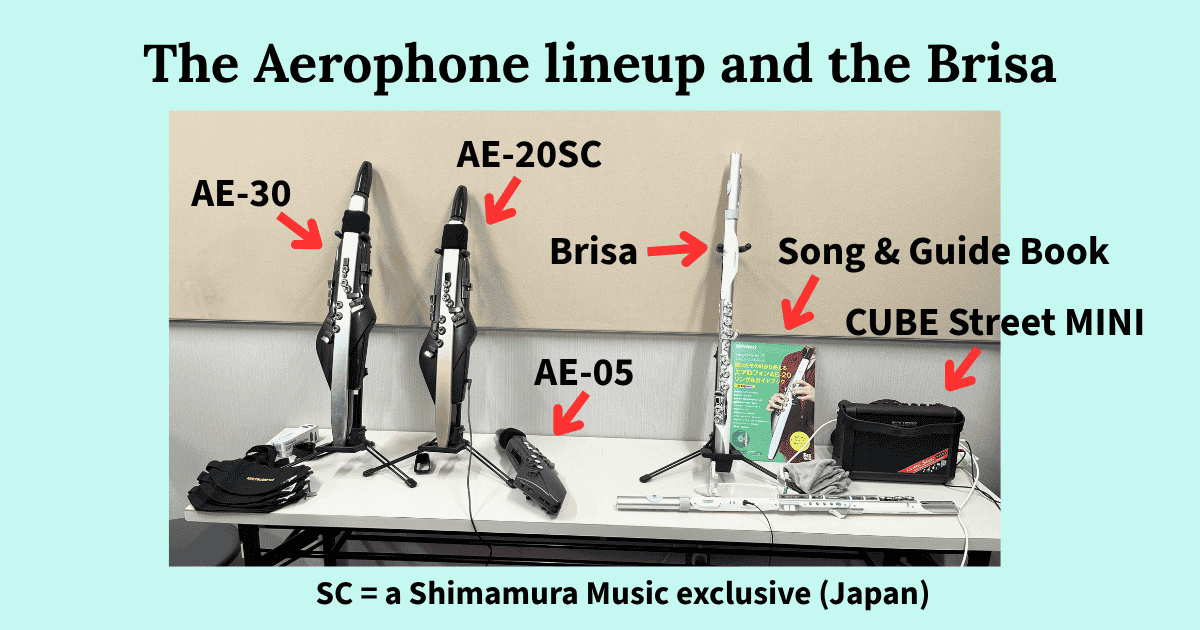
After the seminar, the Aerophone models and the Brisa were set out so that people could try them.
The Brisa drew a crowd. People picked it up and played it with the flute instructor beside them, showing them how.
Roland Aerophone Brisa
See full specs and details on the official page:
Roland Aerophone Brisa — Official Product Page
Summary
This was a report from the Aerophone seminar at Shimamura Music.
It opened with the AE-20, moved through the lecture, the Brisa, the talk session, and the ensemble. An hour packed with things to see, and it went by quickly.
Being there for the Aerophone's 10th anniversary meant a lot to me.
I came away wanting to play better myself.
I am looking forward to seeing the Aerophone grow from here. I want to spend the next 10 years with it too.
There is more I could write about. It was that kind of afternoon.
Thank you to Mr. Fujimoto, to everyone at Shimamura Music, and to everyone at Roland Corporation.
I am already looking forward to next year.